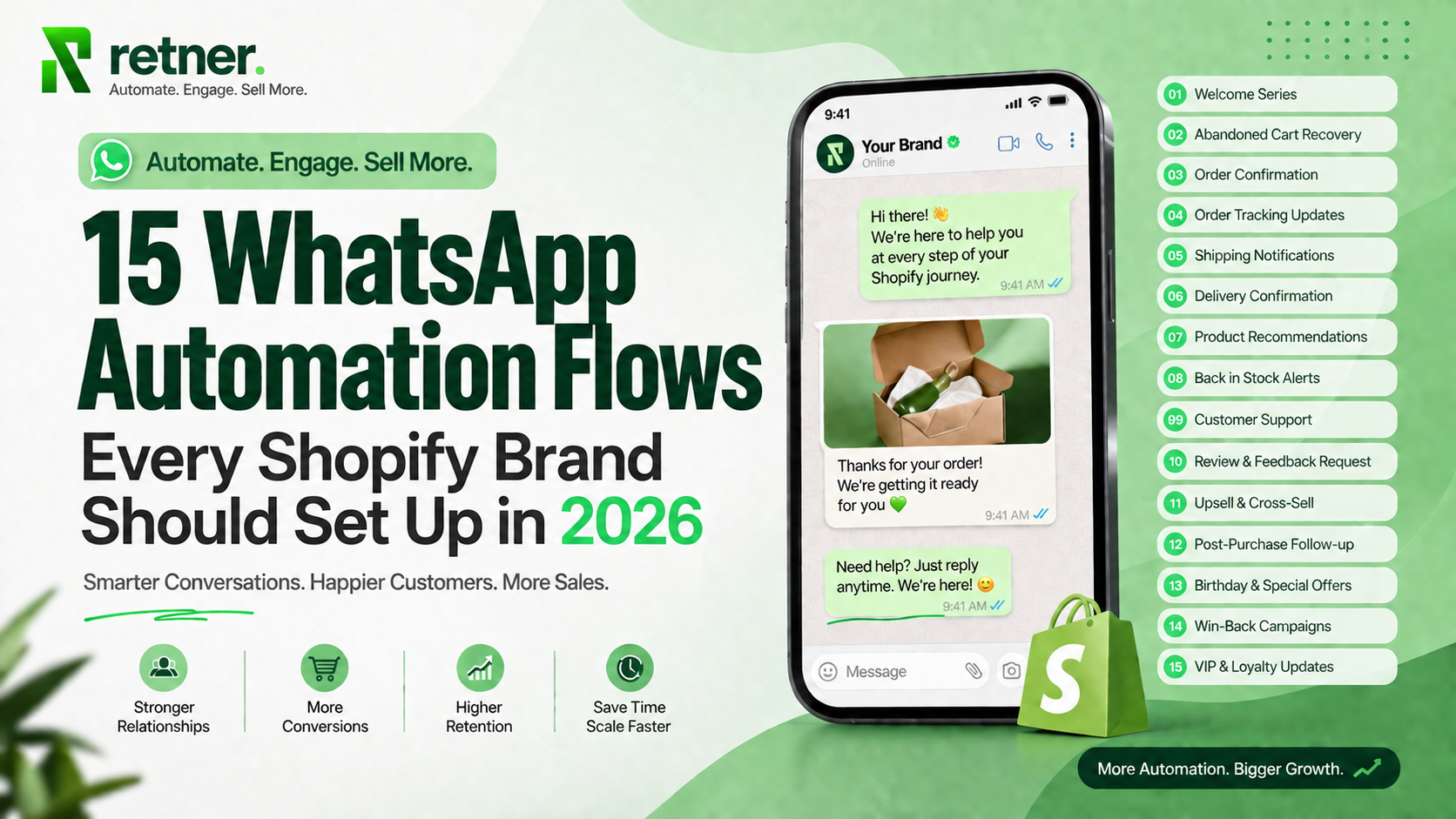
15 WhatsApp Automation Flows Every Shopify Brand Should Set Up in 2026
Most Shopify brands using WhatsApp automation are running three flows: abandoned cart, order confirmation, and a broadcast they send once a month.
That is not WhatsApp automation. That is WhatsApp underutilisation.
The brands growing fastest in Indian D2C in 2026 are running 10–15 connected flows — each triggered by a specific customer behaviour, each serving a specific purpose in the customer journey, and each working together to create what feels to the customer like a seamless, personal brand experience.
<cite index="46-1">Automated customer journeys such as abandoned-cart reminders, order updates, and loyalty prompts deliver average click-through rates of 11.1%, compared with 2.6% for broadcast campaigns.</cite> That gap — 11.1% vs 2.6% — is the entire business case for moving from broadcast to automated flows.
This guide covers all 15 flows your Shopify store should be running — with trigger events, complete message sequences, timing rules, conversion benchmarks, and India-specific pro tips for every single one. If you implement even the first six, you will see measurable revenue impact within 30 days.
1. How to Read This Guide
Each flow in this guide includes:
Trigger: The Shopify or customer event that starts the flow. Target: Which customers receive this flow. Sequence: The complete message timeline — what is sent, when, and what it says. Benchmark: What conversion rate or outcome to expect. Pro Tip: One specific optimisation for Indian D2C context.
2. WhatsApp Flow Pricing Quick Reference
Before building flows, understand Meta's WhatsApp conversation pricing for India (2026):
| Template Category Price per Conversation Best For | ||
| Utility | ₹0.35 | Order confirmations, shipping updates, transactional messages |
| Authentication | ₹0.15 | OTP, verification |
| Marketing | ₹0.88 | Cart recovery, win-back, upsell, broadcasts |
| Service | Free (24-hr window) | Replies to customer-initiated messages |
A 24-hour conversation window means all messages to a customer within 24 hours of the last interaction are billed as a single conversation. Plan your sequences accordingly — multiple messages within 24 hours cost the same as one.
PART 1: ACQUISITION FLOWS (PRE-PURCHASE)
Flow 1 — WhatsApp Welcome Series
Trigger: Customer opts into WhatsApp (via checkout opt-in checkbox, click-to-WhatsApp ad, or website widget).
Target: Every new WhatsApp subscriber — before their first purchase.
Why It Matters: First-time buyers are high-anxiety customers. They discovered your brand somewhere, found you interesting enough to opt in, and now they need one more push to buy. A welcome series gives that push with zero ad spend.
Sequence:
| Step Timing Message | ||
| Message 1 | Immediately on opt-in | "Welcome to [Brand], [Name]! 🎉 You're in — first to know about new drops, offers, and more. Here's a little gift for joining us: [X]% off your first order → [Link]. Valid for 48 hours!" |
| Message 2 | T+24 hours (if no purchase) | "Hey [Name], still thinking? 😊 Here's what makes [Brand] different from the rest: [1-2 line USP]. Thousands of happy customers can't be wrong. Shop now → [Link]" |
| Message 3 | T+48 hours (if still no purchase) | "Last call, [Name] — your welcome offer expires tonight. [X]% off, free delivery on orders above ₹[X]. Don't miss this one → [Link] 🕐" |
Benchmark: 20–35% first-purchase conversion from welcome series within 48 hours.
Pro Tip: Keep Message 1 warm and generous — lead with the offer, not the brand story. Save the brand narrative for Message 2 after you have already earned attention with a concrete incentive.
Flow 2 — Browse Abandonment Recovery
Trigger: Customer visits a product page, spends 60+ seconds, but does not add to cart.
Target: Known customers (existing WhatsApp opt-ins) who browse without buying. Excludes first-time anonymous visitors.
Why It Matters: Browse abandonment is earlier in the intent funnel than cart abandonment — but it is massive in scale. <cite index="40-1">Cart abandonment rates in Indian ecommerce average 60–80%.</cite> Browse abandonment is even higher. Most brands ignore it entirely.
Sequence:
| Step Timing Message | ||
| Message 1 | T+2 hours after browse | "Hey [Name], saw you checking out [Product Name] 👀 Still thinking about it? Here's everything you need to decide: [Product link with image, key features, price]" |
| Message 2 | T+24 hours (if no cart add) | "A lot of our customers had the same hesitation — then loved it. Here's what they said: ⭐⭐⭐⭐⭐ '[Testimonial snippet]'. See [Product] → [Link]" |
Benchmark: 4–8% conversion to purchase from browse abandonment flow.
Pro Tip: Do not pitch too hard in Message 1 — it comes across as surveillance. Frame it as helpful information delivery. Message 2 is where social proof does the heavy lifting.
Flow 3 — Abandoned Cart Recovery
Trigger: Customer adds product(s) to cart but does not complete checkout within 30 minutes.
Target: All customers with a WhatsApp opt-in who have an active cart. Intent-score high-intent customers (checkout reached, multiple visits, COD, high AOV) for faster trigger timing and possible voice cascade escalation.
Why It Matters: This is the single highest-ROI WhatsApp flow for any D2C brand. <cite index="39-1">D2C brands with well-configured WhatsApp abandoned cart sequences typically recover 12–18% of abandoned carts — significantly higher than email abandoned cart recovery rates of 5–8%.</cite>
Sequence:
| Step Timing Message | ||
| Message 1 | T+30–60 min | "Hey [Name]! 🛒 You left [Product Name] in your cart. It's still waiting for you — but stock is limited. Complete your order → [Checkout Link] Need help? Just reply here!" |
| Message 2 | T+6 hours (if no purchase) | "Still there? [X] people added [Product] to their cart today. Here's what our customers are saying: ⭐⭐⭐⭐⭐ '[Review]'. Grab yours before it's gone → [Link]" |
| Message 3 | T+24 hours (if no purchase) | "Last chance, [Name] — your cart expires soon 🕐 Complete your order and we'll add [free gift/discount/free shipping] as a thank you. → [Link with incentive applied]" |
Benchmark: 12–18% cart recovery rate from 3-message sequence. First message alone recovers 8–10%.
Pro Tip: Message 3 should have the incentive already applied in the link — not a code the customer has to remember to enter. Every extra step in checkout loses customers.
Flow 4 — Price Drop Alert
Trigger: A product that a customer previously browsed (and did not buy) goes on sale or drops in price.
Target: Customers who viewed the product page for 45+ seconds but did not purchase — and whose Shopify record shows the product they browsed has now been discounted.
Why It Matters: This flow is almost completely unused by Indian D2C brands — yet it reaches customers at the exact moment their previous barrier (price) has been removed. It converts at dramatically higher rates than a generic sale broadcast because it is personal and behaviour-triggered.
Sequence:
| Step Timing Message | ||
| Message 1 | Within 1 hour of price drop | "Hey [Name]! Great news 🎉 The [Product Name] you were checking out has dropped to ₹[New Price] (from ₹[Old Price]). This is your moment → [Link] Limited stock at this price!" |
Benchmark: 15–25% conversion rate from price drop alerts (highest single-message conversion of any flow).
Pro Tip: Reference the specific product with the old and new price explicitly. "Dropped to ₹849" is 10x more compelling than "On sale now." Specificity drives urgency.
PART 2: CONVERSION FLOWS (AT PURCHASE)
Flow 5 — COD Verification + Prepaid Conversion
Trigger: Customer places a COD order on Shopify.
Target: All COD customers — every single one, no exceptions.
Why It Matters: <cite index="11-1">COD returns at 26% nationally. Prepaid returns at under 2%. COD is 13x worse.</cite> A WhatsApp verification flow that catches even 30% of potential RTOs before dispatch — combined with a 12–18% COD-to-prepaid conversion — dramatically changes a brand's unit economics.
Sequence:
| Step Timing Message | ||
| Message 1 | T+2 minutes after order | "Hi [Name]! Your [Product Name] order (₹[Amount], COD) is confirmed 🎉 Order #[ID]. Switch to online payment now and save ₹[X] instantly → [Prepaid Link]. Reply YES to confirm COD or tap the link to pay online." |
| Message 2 (if YES or no response) | T+5 min | "Thanks for confirming! Just one last thing — is your delivery address correct? [Address]. Reply 1 if correct or 2 to update." |
| Message 3 (AI Voice Trigger) | T+25 min if unread | AI Voice call fires → see Day 2 blog for full cascade |
| Message 4 (if unanswered) | T+45 min | SMS: "Hi [Name], confirm your [Brand] order #[ID] — reply YES to confirm or NO to cancel. Valid 2 hours." |
Benchmark: 70–80% COD confirmation rate within 1 hour; 12–18% COD-to-prepaid conversion; 25–35% RTO reduction.
Pro Tip: Make the prepaid incentive specific and meaningful — ₹50 off for a ₹600 order is 8.3% discount, which feels significant. For orders above ₹2,000, offer free express shipping instead of a discount — it feels more premium.
Flow 6 — Order Confirmation + Trust Building
Trigger: Customer completes any order (COD or prepaid) on Shopify.
Target: All customers immediately post-purchase.
Why It Matters: The post-purchase moment is peak brand anxiety for first-time buyers. "Did my order go through? Is this brand legit? When will it arrive?" A WhatsApp confirmation answers all three questions instantly — building trust and reducing "where is my order" support queries by 40–60%.
Sequence:
| Step Timing Message | ||
| Message 1 | Immediately after order | "Your order is confirmed, [Name]! ✅ Order #[ID]: [Product Name] — ₹[Amount]. Expected delivery: [Date]. We'll keep you updated every step of the way right here on WhatsApp. Thank you for choosing [Brand] 🙏" |
| Message 2 | T+1 hour (for first-time buyers) | "While we prepare your order, here's how to get the most out of [Product]: [Usage tip or product education link]. Any questions? We're right here — just reply!" |
Benchmark: 95%+ open rate; 40–60% reduction in WISMO (Where Is My Order) support tickets.
Pro Tip: Add the product image and brand logo in Message 1 using WhatsApp's media template. A visual confirmation feels far more premium than plain text — and reduces buyer's remorse significantly.
PART 3: FULFILMENT FLOWS (POST-PURCHASE, PRE-DELIVERY)
Flow 7 — Shipping & Tracking Updates
Trigger: Specific Shopify/logistics events: order dispatched, out for delivery, delivered.
Target: All customers with active orders.
Why It Matters: Customers in India check their order status obsessively. Every missed tracking update creates a support ticket. Proactive shipping updates convert from cost-centre to trust-builder — and each update is an opportunity for a subtle additional engagement.
Sequence:
| Step Trigger Event Message | ||
| Dispatch Notification | Order dispatched | "Great news, [Name]! Your [Product] is on its way 🚚 Tracking ID: [ID] via [Courier]. Track here → [Link]. Estimated delivery: [Date]. We're excited for you to receive it!" |
| Out for Delivery | Courier marks OFD | "Your [Brand] order is out for delivery today 📦 Our courier will call before arriving. COD: keep ₹[Amount] ready. Any issues? Just reply here!" |
| Delivered | Courier marks delivered | "Delivered! 🎉 Hope you love your [Product], [Name]. If you have any questions about using it, we're right here. And if something isn't right — just reply to this message, we'll sort it immediately." |
Benchmark: 90%+ open rate on transactional updates; 40% reduction in delivery-related support queries.
Pro Tip: On the "Delivered" message, resist the urge to immediately ask for a review. Wait 24–48 hours. A review request within seconds of delivery feels automated and disrespectful. Let the customer experience the product first.
Flow 8 — Pre-Delivery Reminder + Day-Of Alert
Trigger: Logistics system confirms delivery date (day before) and order is out for delivery (day of).
Target: All customers — with extra emphasis on COD orders (where failed delivery = direct RTO risk).
Why It Matters: First-attempt delivery failure is the gateway to NDR and RTO. A pre-delivery reminder that prepares the customer reduces first-attempt failure by 15–25% — at a cost of one WhatsApp message.
Sequence:
| Step Timing Message | ||
| Day-Before Alert | 6–8 PM the evening before delivery | "Hi [Name], your [Product] is arriving tomorrow! 🚚 Our delivery partner will come between 10 AM and 7 PM to [Address]. Please ensure someone is available. COD: Keep ₹[Amount] ready. Need to reschedule? Reply RESCHEDULE." |
| Day-Of SMS Alert | 8–9 AM delivery morning | "Out for delivery today! Your [Brand] order is on the way. Courier will call before arriving. COD amount: ₹[Amount]." |
Benchmark: 15–25% reduction in first-attempt delivery failure; 10–18% decrease in NDR rate.
Pro Tip: Include the exact COD amount in the day-before message — not just "please keep cash ready." Customers who know the exact amount are far more likely to have it ready. Vagueness leads to "let me find change" delays that cause couriers to leave.
Flow 9 — NDR Recovery
Trigger: Courier partner sends an NDR (Non-Delivery Report) — the first delivery attempt has failed.
Target: All customers with a failed delivery attempt — with urgency, since each hour of delay increases RTO probability.
Why It Matters: An NDR that is not addressed within 24 hours has a 70%+ chance of becoming an RTO. A WhatsApp NDR flow — followed by AI Voice if unanswered — recovers 65–80% of at-risk deliveries before they become RTOs.
Sequence:
| Step Timing Message | ||
| Message 1 | Within 30 min of NDR | "Hi [Name], we tried delivering your [Product] today but couldn't reach you 😔 We want to make sure you get it! Reply: 1️⃣ Reschedule for tomorrow · 2️⃣ Update delivery address · 3️⃣ Cancel order. What works for you?" |
| AI Voice | T+60 min if unread | AI voice agent calls to rescue delivery (see Day 2 cascade) |
| Message 2 | T+4 hours if no response | "Last chance to save your order, [Name]. Our courier will make one final attempt tomorrow. Confirm your availability → [Link] or reply YES for tomorrow delivery." |
Benchmark: 65–80% NDR rescue rate with full cascade; 35–45% from WhatsApp alone.
Pro Tip: Use numbered emoji reply options (1️⃣ 2️⃣ 3️⃣) in your NDR message. They dramatically increase response rate — customers can reply with a single character rather than typing a full response. Lower friction = higher engagement.
PART 4: RETENTION FLOWS (POST-DELIVERY)
Flow 10 — Post-Purchase Onboarding
Trigger: Order confirmed as delivered by courier.
Target: All customers — with especially detailed onboarding for first-time buyers and high-consideration categories (supplements, skincare, electronics accessories, baby care).
Why It Matters: A customer who uses your product correctly loves it more, returns it less, and reorders sooner. <cite index="48-1">A customer may not understand the product routine, delivery expectations, ingredient details, size choice, or support path. If the brand disappears after payment, the second purchase becomes accidental.</cite> Onboarding makes the second purchase intentional.
Sequence:
| Step Timing Message | ||
| Message 1 | T+1 day after delivery | "How's your [Product] treating you so far, [Name]? 😊 Just checking in — here's a quick tip to get the best results: [1 key usage tip with image or short video link]" |
| Message 2 | T+3 days | "Day 3 with [Product] — the best is coming! [Additional usage tip or FAQ answer]. Any questions? Just reply — we're right here 24/7." |
| Message 3 | T+7 days | "One week with [Product], [Name]! How are you finding it? We'd love to hear — and if there's anything we can improve, reply to this message. We read every response." |
Benchmark: 30–45% reduction in product-related returns; 20–30% improvement in repeat purchase rate for onboarded customers vs non-onboarded.
Pro Tip: For Tier 2 and Tier 3 customers, send the Day 1 usage tip as a short video (under 60 seconds) in Hinglish rather than text. Video consumption rates are extremely high in these markets and the product education sticks better.
Flow 11 — Review Collection
Trigger: Order confirmed delivered + 2–3 days passed since delivery (category-dependent).
Target: All successfully delivered customers. Prioritise first-time buyers — their reviews are most valuable for social proof.
Why It Matters: Reviews are the single most valuable asset for D2C conversion. More reviews → higher trust → better conversion on product pages → lower CAC. WhatsApp review collection achieves 30–45% response rates vs 5–10% for email.
Sequence:
| Step Timing Message | ||
| Message 1 | T+2 days after delivery | "Hi [Name], hope you're loving your [Product]! 🌟 Would you mind sharing a quick review? It takes under a minute and helps us improve — and it means the world to new customers deciding whether to try us. → [Review Link]" |
| Message 2 | T+5 days (if no review) | "One last nudge, [Name] 😊 Your review of [Product] could help someone else make the decision you made. One tap → [Short Review Link]. Thank you!" |
Benchmark: 30–40% review response rate from 2-message sequence.
Pro Tip: Personalise the review request by referencing the specific product. "Review your Royal Blue Kurta Set" converts significantly better than "Leave us a review." Also: if the customer had a support issue in the last 7 days, suppress the review request until it's resolved.
Flow 12 — Upsell + Cross-Sell
Trigger: Order delivered + 3–5 days post-delivery (after onboarding messages have built goodwill).
Target: Customers who purchased Product A and whose behavioural profile suggests affinity for Product B (based on purchase history, browsing patterns, or product affinity data).
Why It Matters: Upsell and cross-sell revenue from existing customers has zero acquisition cost. A customer who just received and likes their first order is at peak receptivity to a complementary product recommendation.
Sequence:
| Step Timing Message | ||
| Message 1 | T+5 days post-delivery | "Since you loved [Product A], we thought you'd love this too 💡 Customers who bought [Product A] also love [Product B] — and together they [specific benefit]. See [Product B] → [Link with product image]" |
| Message 2 | T+7 days (if no purchase) | "Still thinking about [Product B]? Here's what customers who use both [A] + [B] are saying: ⭐⭐⭐⭐⭐ '[Combined use testimonial]'. Shop the pair → [Bundle Link]" |
Benchmark: 8–15% cross-sell conversion rate; 25–40% increase in average order value for customers who engage with cross-sell flows.
Pro Tip: Frame the cross-sell around a specific combined benefit — "Together they give you [X]" — rather than just "you might also like." The former creates desire; the latter feels like a generic Amazon recommendation.
Flow 13 — Reorder / Replenishment Reminder
Trigger: Time-based trigger, calculated from average consumption cycle of the product (typically 25–35 days after delivery for consumables).
Target: Customers who purchased consumable products — supplements, skincare, personal care, food, cleaning products. Any product that runs out.
Why It Matters: Replenishment reminders sent before the customer runs out are the single highest-converting WhatsApp message type for consumable D2C brands — because the customer already knows they need the product, and you are simply making reordering frictionless.
Sequence:
| Step Timing Message | ||
| Message 1 | Day 25 post-delivery (for 30-day products) | "Hi [Name]! 📦 You ordered [Product] about a month ago — most customers find they start running low around now. Want to reorder before you run out? Tap to reorder in one click → [One-Click Reorder Link]" |
| Message 2 | Day 30 (if no reorder) | "Running low on [Product], [Name]? 🚨 Reorder today and get [free shipping/X% off/free gift] — loyal customer offer, valid for 48 hours → [Reorder Link]" |
Benchmark: 22–35% reorder conversion rate from replenishment reminder flow.
Pro Tip: Build the replenishment trigger based on the actual product consumption cycle — not a generic 30-day timer. A 60-tablet supplement taken twice daily lasts 30 days. A 200ml serum used daily lasts 40–50 days. Accurate timing dramatically improves relevance and conversion.
PART 5: RE-ENGAGEMENT FLOWS
Flow 14 — Win-Back (60–90 Day Lapsed Customers)
Trigger: Customer has not purchased in 60 days (for high-frequency categories) or 90 days (for low-frequency categories) since their last order.
Target: Customers who previously purchased at least once and have been inactive for the defined window. Exclude customers who are in an active support escalation.
Why It Matters: Lapsed customers are far more valuable than new cold leads — they have already purchased, they know your brand, and their churn is reversible. Win-back via WhatsApp consistently outperforms email because the message lands in a higher-attention environment.
Sequence:
| Step Timing Message | ||
| Message 1 | Day 60/90 of inactivity | "Hey [Name], we've missed you! 👋 It's been a while since your last order and we wanted to check in. We've got some exciting new arrivals since you were here — and a little something to welcome you back: [X]% off, just for you → [Link]. Valid for 72 hours." |
| Message 2 | T+48 hours (if no purchase) | "Your welcome-back offer expires soon, [Name] ⏰ Here's what other customers who came back loved: [New product / bestseller + image]. Grab it before your offer disappears → [Link]" |
| Message 3 | T+72 hours (last attempt) | "Final reminder, [Name] — your exclusive offer expires tonight. We'd love to have you back. If there was something we could have done better last time, reply to this message — we genuinely want to know. And if you're ready → [Link] 🙏" |
Benchmark: 12–20% win-back conversion rate from 3-message sequence.
Pro Tip: Message 3 should invite feedback ("reply to this message — we genuinely want to know") in addition to the purchase CTA. Some lapsed customers reply with a reason (bad product experience, found a competitor) — this gives you invaluable retention intelligence and sometimes converts the customer through conversation.
Flow 15 — Product Launch Early Access
Trigger: New product launch event — triggered manually or via Shopify product creation webhook.
Target: Your most engaged WhatsApp subscribers — customers who have purchased 2+ times, customers who have opened 3+ WhatsApp messages, or customers tagged as "VIP" in your CRM. This is not a broadcast to your entire list — it is exclusive early access.
Why It Matters: Product launches via WhatsApp early access create two things simultaneously: scarcity and exclusivity. Customers who receive early access feel valued, and brands consistently see 20–35% of launch day sales come from the WhatsApp early access window — before the product is publicly announced on Instagram or email.
Sequence:
| Step Timing Message | ||
| Message 1 | 24 hours before public launch | "Big news, [Name] 🎉 You're getting early access to something we're really proud of — [Product Name]. It drops publicly tomorrow, but you get first pick, right now → [Early Access Link]. Don't wait — early access closes in 24 hours." |
| Message 2 | 4 hours before public launch | "Only a few hours left, [Name]. [X] units already claimed by early access customers. Your window closes at [Time] → [Link]" |
| Message 3 | Launch day (for non-purchasers) | "[Product Name] is officially live 🚀 You had first look — it's now available to everyone. If you haven't grabbed yours yet → [Link]. Selling fast." |
Benchmark: 20–35% conversion rate from early access list; 3–5x higher conversion than launch-day broadcast to cold subscribers.
Pro Tip: Never give early access to your entire WhatsApp list. Exclusivity is the key mechanism. If everyone gets early access, no one feels special. Segment your top 10–15% most engaged customers and protect the exclusivity signal fiercely.
Priority Order: Which Flows to Set Up First
Do not try to build all 15 flows at once. Here is the recommended rollout order based on ROI-to-effort ratio:
Week 1 — Must-Have (Highest ROI)
- ✅ Flow 5: COD Verification + Prepaid Conversion
- ✅ Flow 6: Order Confirmation + Trust Building
- ✅ Flow 3: Abandoned Cart Recovery
- ✅ Flow 7: Shipping & Tracking Updates
Week 2 — High Impact
- ✅ Flow 8: Pre-Delivery Reminder
- ✅ Flow 9: NDR Recovery
- ✅ Flow 11: Review Collection
- ✅ Flow 13: Reorder / Replenishment Reminder
Week 3–4 — Growth Layer
- ✅ Flow 1: Welcome Series
- ✅ Flow 10: Post-Purchase Onboarding
- ✅ Flow 12: Upsell + Cross-Sell
- ✅ Flow 14: Win-Back
Month 2+ — Advanced
- ✅ Flow 2: Browse Abandonment
- ✅ Flow 4: Price Drop Alert
- ✅ Flow 15: Product Launch Early Access
ROI Summary: What 15 Flows Deliver vs 3 Flows
| Metric 3 Flows (Basics) 15 Flows (Full Stack) | ||
| Cart recovery rate | 8–10% | 16–22% |
| COD RTO rate | 25–35% | 12–16% |
| Repeat purchase rate (90 days) | 10–15% | 28–38% |
| Average review response rate | 5–8% | 30–40% |
| NDR rescue rate | 20–30% | 65–80% |
| Monthly incremental revenue (₹40L brand) | ₹2–3L | ₹7–12L |
Frequently Asked Questions
Which WhatsApp automation flows give the fastest ROI for Shopify brands?
The four flows with the fastest measurable ROI are: COD verification + prepaid conversion (visible within 1 week as RTO reduction), abandoned cart recovery (visible within the first campaign), order confirmation (immediate reduction in support tickets), and NDR recovery (immediate impact on rescue rate). Set these four up first — they typically pay for the entire platform cost within the first 30 days.
How many WhatsApp messages can I send to a customer per day?
Meta does not set a strict daily limit per customer, but best practice is never more than 1–2 messages per day per customer from any single flow. Your WhatsApp platform should have global suppression rules that prevent a customer from receiving messages from multiple flows on the same day — for example, a customer should not receive a cart recovery message and a win-back message on the same day.
Do I need WhatsApp Business API for automation flows on Shopify?
Yes. WhatsApp automation flows for Shopify require the WhatsApp Business API — not the regular WhatsApp Business app. The API gives you access to approved message templates, automated triggers, and the ability to send outbound messages to opted-in customers. Platforms like Retner handle the API setup for you — you do not need to apply to Meta directly.
How do I collect WhatsApp opt-ins on my Shopify store?
The most effective opt-in channels for Indian D2C Shopify stores are: a checkbox at checkout ("Send me order updates and offers on WhatsApp"), a click-to-WhatsApp button on the website, Click-to-WhatsApp ads on Instagram and Facebook, and QR codes on product packaging. Opt-in must be explicit and clearly state the customer will receive messages from your brand on WhatsApp.
What is the difference between utility and marketing WhatsApp templates?
Utility templates (₹0.35/conversation) are for transactional messages directly related to an order — confirmations, shipping updates, delivery alerts, COD verification. Marketing templates (₹0.88/conversation) are for promotional messages — cart recovery offers, win-back discounts, product launches, upsells. Use utility templates wherever possible to minimise cost, and reserve marketing templates for high-value, revenue-generating messages.
How long does it take to set up all 15 WhatsApp automation flows on Shopify?
With a platform like Retner that has native Shopify integration and pre-built flow templates, you can have the first four flows live within 3–5 days (pending WhatsApp template approval, which takes 24–72 hours). The full stack of 15 flows typically takes 3–4 weeks — two weeks of setup and one to two weeks of testing and optimisation.
Can WhatsApp automation flows work in Hindi or regional languages?
Yes. WhatsApp Business API supports all Indian languages including Hindi, Gujarati, Tamil, Telugu, Kannada, Bengali, Marathi, and Punjabi. For D2C brands with significant Tier 2 and Tier 3 customer bases, running flows in Hinglish or the dominant regional language of your customer base consistently improves open rates and response rates. Retner supports multi-language flow configuration based on customer pincode.
Ready to build all 15 flows for your Shopify store in one platform? See how Retner makes it happen — Book a free demo →
Tags: WhatsApp automation flows, Shopify WhatsApp India, D2C WhatsApp marketing, abandoned cart WhatsApp, COD verification WhatsApp, WhatsApp NDR recovery, WhatsApp reorder reminder, WhatsApp win-back, product launch WhatsApp, omnichannel D2C India Schema Markup: FAQPage, Article, HowTo, Table Internal Links: /whatsapp-automation, /ai-voice-calling, /abandoned-cart-recovery, /rto-reduction, /cod-to-prepaid Author: Team Retner CTA: Book a Demo
8x Return On WhatsApp Ads Spend.
Book a demo and we will get you started on proven WhatsApp marketing strategies