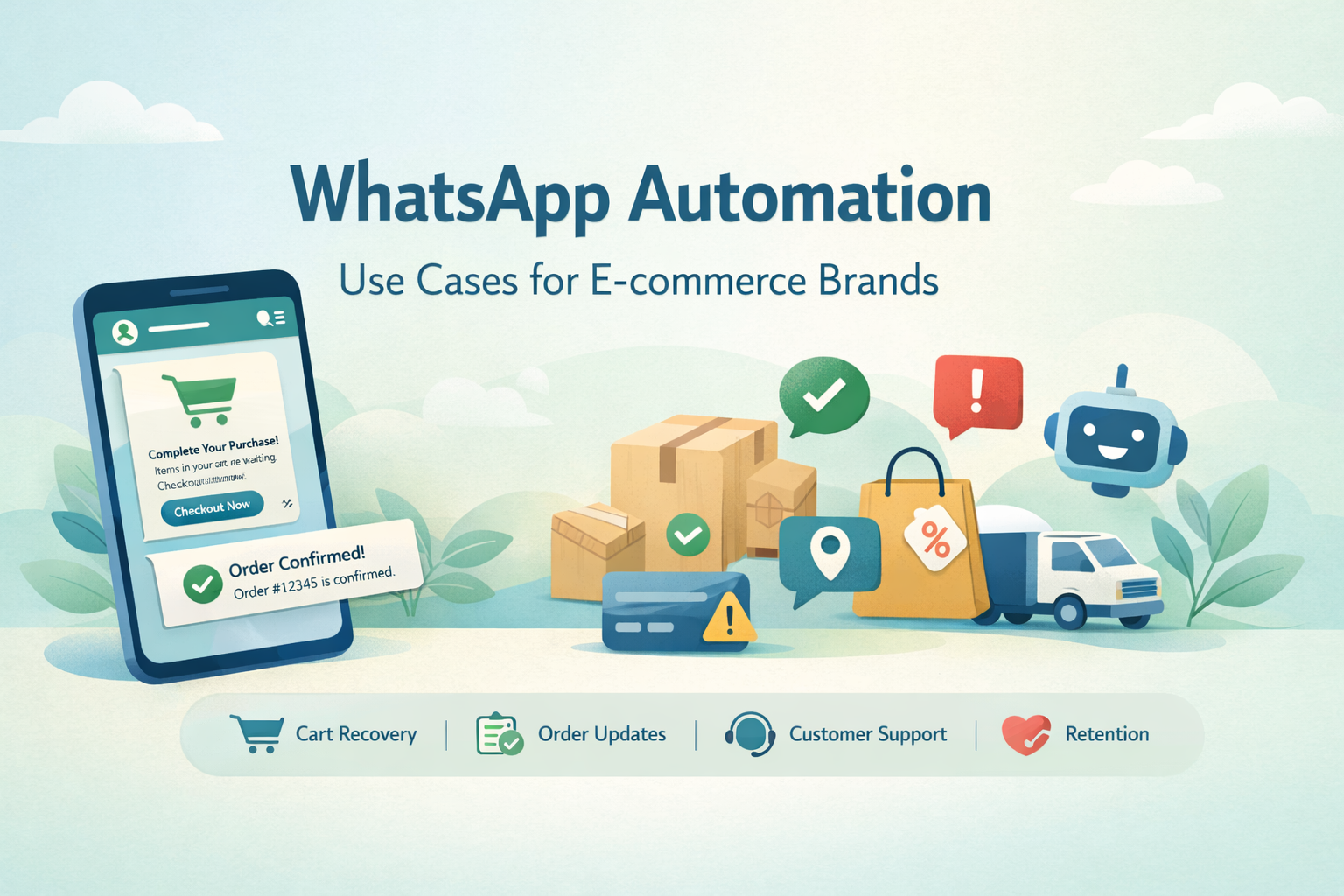
WhatsApp automation helps e-commerce brands communicate with customers in real time across the buying journey. It is commonly used for order updates, cart recovery, customer support, and retention workflows where speed, clarity, and response rates matter.
This article explains practical WhatsApp automation use cases for e-commerce, how they work, and where they add measurable value.
What Is WhatsApp Automation in E-commerce?
WhatsApp automation in e-commerce refers to the use of automated workflows, templates, and triggers to send messages to customers on WhatsApp based on specific actions or events.
Common triggers include:
- Order placed
- Cart abandoned
- Payment failed
- Order shipped or delivered
- Customer reply or keyword input
Automation is typically implemented using the WhatsApp Business API and integrated with platforms like Shopify or WooCommerce.
Why E-commerce Brands Use WhatsApp Automation
E-commerce brands adopt WhatsApp automation because:
- WhatsApp messages have significantly higher open rates than email or SMS
- Messages are delivered instantly and read quickly
- Conversations feel personal even when automated
- It reduces manual customer support workload
- It improves conversion, retention, and post-purchase experience
Core WhatsApp Automation Use Cases for E-commerce
1. Abandoned Cart Recovery
What it does:
Automatically reminds customers who added products to cart but didn’t complete checkout.
How it works:
- The trigger fires after cart inactivity (e.g., 30–60 minutes)
- The message includes product name, image, price, and checkout link
- Follow-ups can be scheduled if there is no response
Why it matters:
- Recovers lost revenue
- Works especially well for mobile-first shoppers
- Enables contextual nudges instead of discounts
2. Order Confirmation Messages
What it does:
Sends instant confirmation after a successful order.
Typical content:
- Order ID
- Items purchased
- Payment method
- Delivery address summary
Benefits:
- Reduces customer anxiety
- Decreases “Did my order go through?” support tickets
- Establishes trust immediately after purchase
3. Shipping & Delivery Updates
What it does:
Keeps customers informed throughout fulfillment.
Common messages:
- Order shipped
- Tracking link shared
- Out for delivery
- Delivered successfully
Why it’s effective:
- Customers expect real-time updates
- Reduces WISMO (“Where is my order?”) queries
- Improves overall post-purchase experience
4. COD Order Verification & RTO Reduction
What it does:
Confirms cash-on-delivery orders before dispatch.
How it works:
- Automated confirmation message after COD order
- The customer confirms or cancels with a button or reply
- Unconfirmed orders can be held or canceled
Impact:
- Reduces Return-to-Origin (RTO)
- Saves logistics and warehousing costs
- Filters low-intent COD orders early
5. Payment Failure & Retry Notifications
What it does:
Re-engages customers whose payment failed during checkout.
Automation flow:
- Detect failed transaction
- Send a retry link on WhatsApp
- Optionally provide support or alternate payment options
Why it works:
- Catches high-intent customers
- Faster than email follow-ups
- Prevents silent drop-offs
6. Customer Support Automation
What it does:
Automates common support queries using predefined flows.
Typical queries handled:
- Order status
- Return or refund policy
- Delivery timelines
- Store information
Benefits:
- 24/7 availability
- Faster first response time
- Reduces human agent workload
Complex issues can still be escalated to live agents.
7. Post-Delivery Follow-Ups
What it does:
Engages customers after delivery.
Examples:
- Delivery confirmation
- Usage tips or care instructions
- Feedback or review request
Why it matters:
- Improves customer satisfaction
- Encourages repeat engagement
- Opens the door for retention workflows
8. Repeat Purchase & Replenishment Reminders
What it does:
Reminds customers to repurchase consumable or repeat-use products.
How it works:
- Triggered based on delivery date or product lifecycle
- Message sent after estimated usage period
- Includes quick reorder link
Best suited for:
- Supplements
- Skincare
- FMCG
- Pet food
9. Personalized Product Recommendations
What it does:
Suggests relevant products based on past behavior.
Signals used:
- Previous purchases
- Browsing activity
- Customer segment (new vs repeat)
Value:
- Increases average order value
- Feels contextual rather than promotional
- Works well when combined with conversational flows
10. Win-Back & Re-Engagement Campaigns
What it does:
Reactivates inactive customers.
Common triggers:
- No purchase in 60–90 days
- No response to previous campaigns
Typical approach:
- Soft reminder
- Value-based message (not always discounts)
- Option to re-enter support or product discovery flow
WhatsApp Automation vs Manual Messaging
| Aspect | Manual WhatsApp | Automated WhatsApp |
| Speed | Slow | Instant |
| Scalability | Limited | High |
| Consistency | Variable | Standardized |
| Personalization | Manual effort | Rule-based |
| Support load | High | Reduced |
Common Mistakes E-commerce Brands Make
- Sending too many promotional messages
- Automating without proper customer consent
- Not separating utility and marketing messages
- Ignoring post-purchase automation
- Treating WhatsApp like bulk SMS
Automation works best when messages are timely, relevant, and contextual.
FAQs
Is WhatsApp automation allowed for e-commerce?
Yes, when implemented via the WhatsApp Business API and compliant with opt-in and template rules.
Can WhatsApp automation replace customer support teams?
No. It reduces workload but should complement human support, not replace it entirely.
Does WhatsApp automation work better than email?
It depends on the use case. WhatsApp performs better for urgent, transactional, and conversational messages.
Is WhatsApp automation only for large brands?
No. Small and mid-sized D2C brands often see faster ROI due to lower scale complexity.
Summary
WhatsApp automation enables e-commerce brands to:
- Recover abandoned carts
- Reduce RTO
- Improve post-purchase experience
- Increase repeat purchases
- Scale customer communication efficiently
When used thoughtfully, it becomes a core part of an omnichannel retention strategy rather than just a marketing channel.
Platforms like Retner focus on using WhatsApp automation alongside email, SMS, and other channels to create coordinated, customer-centric journeys instead of isolated campaigns.
8x Return On WhatsApp Ads Spend.
Book a demo and we will get you started on proven WhatsApp marketing strategies