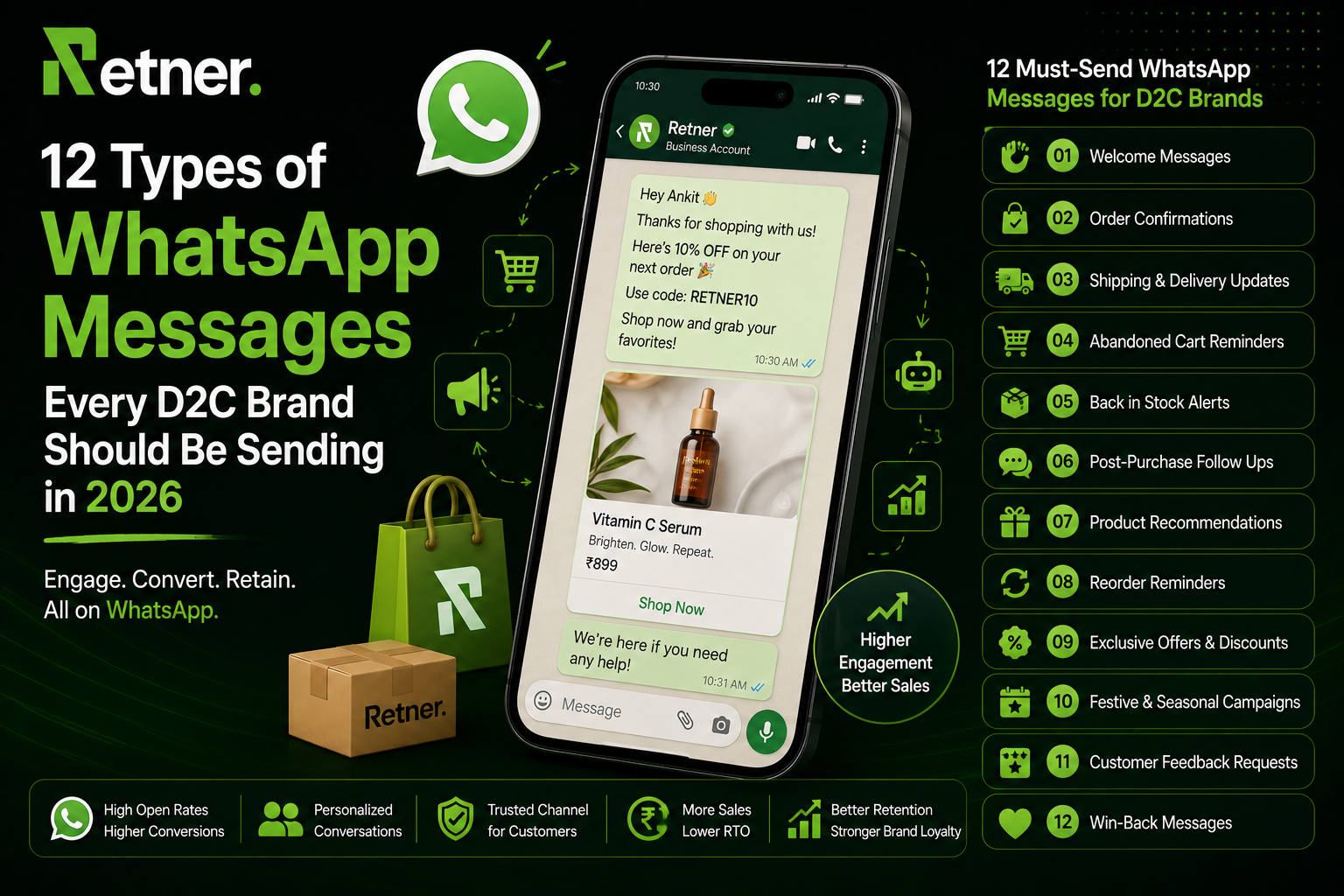
12 Types of WhatsApp Messages Every D2C Brand Should Be Sending in 2026 (With Examples)
Something significant is happening to D2C marketing budgets in India in 2026.
CPMs on Meta and Google have increased significantly post-ATT. D2C brands that built over-reliance on paid social are now looking for owned channels. WhatsApp is the most powerful owned channel available in India.
For the first time, major D2C brands are actively shifting budget away from paid acquisition toward WhatsApp — not as a support inbox, but as a full-funnel marketing channel. The economics are simply too compelling to ignore: 90%+ open rates, 25–40% CTR on automated journeys, and the ability to reach 500 million Indian users in a channel they check before they check anything else.
The convergence of messaging and payment within a single app — WhatsApp Pay and UPI integration — creates a frictionless purchase journey that no other channel in India currently replicates.
But most D2C brands using WhatsApp are only scratching the surface. They run 2–3 message types — usually abandoned cart, order confirmation, and a monthly broadcast — and leave significant revenue on the table from the other 9 message types that could be running on autopilot.
This guide covers all 12 — what each one does, when it fires, what it should say, and what return to expect. For the complete template copy for each type, see our full library: 20 WhatsApp Message Templates for D2C Brands — Copy-Paste Ready.
The 12 Message Types — Overview
| Type | Category | Trigger | Meta Billing |
| 1. Welcome | Acquisition | New opt-in | Marketing |
| 2. Click-to-WhatsApp Ad Follow-Up | Acquisition | Ad click to WA | Marketing |
| 3. Abandoned Cart Recovery | Conversion | Cart abandoned | Marketing |
| 4. Product Recommendation | Conversion | Browse / AI signal | Marketing |
| 5. Flash Sale / Limited Offer | Conversion | Campaign launch | Marketing |
| 6. COD Order Verification | Transactional | COD order placed | Utility |
| 7. Shipping and Delivery Updates | Transactional | Logistics event | Utility |
| 8. NDR Recovery | Transactional | NDR received | Utility |
| 9. Post-Purchase Onboarding | Retention | Order delivered | Utility/Marketing |
| 10. Review Collection | Retention | T+3 days post-delivery | Marketing |
| 11. Reorder / Replenishment | Retention | Consumption cycle | Marketing |
| 12. Win-Back Campaign | Re-engagement | 60–90 day inactive | Marketing |
TYPE 1 — Welcome Message
What it is: The first message a customer receives after opting into your WhatsApp — via checkout checkbox, Click-to-WhatsApp ad, website widget, or QR code.
Why it matters: The brands that win on WhatsApp use opt-in data and AI-assisted timing to convert the intent of a new subscriber immediately — not 48 hours later. The welcome window is your highest-intent moment with a new subscriber. They just chose to hear from you. Act on it.
When to send: Immediately on opt-in — zero delay.
Example:
Hi {{Name}}! Welcome to {{Brand}} 🎉
You're officially in — first to know about new drops,
exclusive offers, and members-only deals.
Here's your welcome gift: {{X}}% off your first order →
{{Link}}
Valid for 48 hours. Happy shopping! 🛍️
Follow-up (T+24 hrs, no purchase):
Still thinking, {{Name}}? 😊
{{Brand USP in one line}}.
Your welcome offer expires in {{X}} hours →
{{Link}}
Benchmark: 20–30% first-purchase conversion from a 2-message welcome series within 48 hours.
Pro Tip: Send the discount link with the code pre-applied — never ask the customer to remember and enter a code at checkout. Every extra step reduces conversion by 15–20%.
TYPE 2 — Click-to-WhatsApp Ad Follow-Up
What it is: When a customer clicks a Meta/Instagram ad that opens WhatsApp directly, they start a conversation. An automated reply fires immediately with a personalised follow-up based on which ad they clicked.
Why it matters now: Rising customer acquisition costs on Meta and Google are driving D2C brands toward Click-to-WhatsApp ads as a lower-cost alternative — because the conversation that starts on WhatsApp can be continued with automated journeys at near-zero marginal cost. The ad gets the click. WhatsApp closes the sale.
When to send: Within 30 seconds of the customer initiating the WhatsApp conversation from the ad.
Example:
Hi {{Name}}! Thanks for your interest in {{Product/Offer}} 🙌
Here's everything you need to know:
✅ {{Benefit 1}}
✅ {{Benefit 2}}
✅ {{Benefit 3}}
Order now → {{Link}}
Free delivery · {{Return Policy}}
Any questions? Just reply here — we're available 24/7!
Benchmark: Click-to-WhatsApp ad campaigns convert at 15–25% — significantly higher than standard landing page traffic from the same ad, because the conversation continues within WhatsApp rather than requiring the customer to navigate an external website.
Pro Tip: Personalise the follow-up message to the specific ad the customer clicked. A customer who clicked your "Vitamin C Serum" ad should receive a message about the Vitamin C Serum — not your generic brand intro. Ad-specific follow-ups convert 2–3x better than generic welcome messages.
TYPE 3 — Abandoned Cart Recovery
What it is: An automated message sent when a customer adds products to their cart but does not complete the purchase.
Why it matters: Cart abandonment in Indian ecommerce averages 65–80%. Every 10 abandoned carts that go uncontacted represent 1–1.4 lost sales at zero recovery cost. A well-structured WhatsApp cart recovery sequence recovers 12–18% of those carts — making it the highest-ROI marketing message type in D2C.
When to send: First message at T+30–60 minutes (High intent: 30 min; Medium intent: 60 min). See What is Buyer Intent Scoring? for how intent level determines timing.
3-Message Sequence:
Message 1 (T+30–60 min):
Hey {{Name}}! 🛒
You left {{Product}} in your cart — it's still waiting.
Only {{Stock}} units left.
Complete your order → {{Checkout Link}}
Need help? Just reply here!
Message 2 (T+6 hrs, no purchase):
Still there, {{Name}}? 😊
{{N}} people bought {{Product}} this week.
⭐⭐⭐⭐⭐ "{{Short Review}}" — {{City}}, verified buyer
Your cart is saved → {{Link}}
Offer expires in {{X}} hours.
Message 3 (T+24 hrs, no purchase):
Last chance, {{Name}} 🕐
Complete your order now and we'll add
{{Incentive}} as a thank you → {{Link with offer}}
Benchmark: 12–18% overall cart recovery from the 3-message sequence. First message alone recovers 8–10%.
Pro Tip: For high-intent customers who reached checkout but did not pay, layer an AI voice call between Message 1 and Message 2. The voice call handles objections that text cannot — and recovers an additional 8–12% of high-intent carts. See the full WhatsApp + AI Voice Cascade guide for the complete flow.
TYPE 4 — Product Recommendation
What it is: A personalised product suggestion sent to a customer based on their browsing behaviour, purchase history, or a specific behavioural trigger — like revisiting a product page they browsed previously.
Why it matters: A customer who repeatedly visits a skincare moisturiser page but never adds it to the cart is treated very differently from someone who adds a product, removes it, and comes back again. Behaviour-based recommendations feel helpful rather than promotional — because they are responding to what the customer is already interested in.
When to send: Triggered by behavioural signals — product page revisit, browse abandonment, cross-sell opportunity post-purchase.
Example (Browse Abandonment):
Hey {{Name}} 👀
Saw you checking out {{Product}} — still thinking about it?
Here's what makes it different:
✅ {{Benefit 1}}
✅ {{Benefit 2}}
✅ {{Benefit 3}}
See {{Product}} → {{Link}}
Any questions? Just reply here!
Example (Post-Purchase Cross-Sell):
Since you got {{Product A}}, you'll love this 💡
{{Product B}} pairs perfectly with {{Product A}} — together
they {{Combined Benefit}}.
{{N}} customers who bought {{Product A}} also love {{Product B}}.
See it here → {{Link}}
Benchmark: Browse abandonment recommendations convert at 4–8%. Post-purchase cross-sell recommendations convert at 8–15%.
Pro Tip: The combined benefit statement in cross-sell messages ("together they give you complete morning skincare in 3 minutes") is the single most important line to get right. Specific benefits convert. Generic "you might also like" does not.
TYPE 5 — Flash Sale and Limited-Time Offer
What it is: A time-limited promotional message announcing a sale, festive offer, or discount — sent to your WhatsApp subscriber list.
Why it matters: Flash sale announcements on WhatsApp consistently outperform every other channel — 90%+ open rates, instant reach, and the ability to create real-time urgency that email and SMS cannot replicate.
When to send: Send to your engaged segment only — customers who have opened at least 2 WhatsApp messages in the past 60 days. Sending to your full list lowers delivery scores and wastes budget on disengaged subscribers.
Example:
🔥 {{SALE NAME}} SALE IS LIVE
{{X}}% off everything → {{Link}}
⏰ Ends in {{N}} hours.
Don't wait — {{N}} items already sold today.
Shop now → {{Link}}
Reply STOP to unsubscribe.
Benchmark: 25–35% CTR from engaged segments. WhatsApp messages in India achieve open rates above 90% compared to 20–25% for email. For D2C brands competing in a crowded paid media landscape, no other channel offers this level of direct customer attention.
Pro Tip: For Diwali, Navratri, Holi, and other festive occasions — segment by purchase history. A customer who bought a kurta set last Diwali should receive a new festive kurta recommendation, not a generic "Diwali Sale" blast. Personalised festive messages achieve 3–5x higher conversion than generic festive broadcasts.
TYPE 6 — COD Order Verification
What it is: A transactional message sent immediately after a COD order is placed, confirming the order and offering a COD-to-prepaid conversion incentive.
Why it matters: COD accounts for 60–65% of Indian D2C orders. Unverified COD orders are the primary driver of India's 20–40% RTO rates. A WhatsApp verification message that captures customer intent — and converts some to prepaid — is the single most impactful operational message a D2C brand can send.
When to send: T+2 minutes after COD order placement.
Example:
Your order is confirmed, {{Name}}! ✅
Order #{{ID}}: {{Product}}
Amount: ₹{{Amount}} (Cash on Delivery)
Expected delivery: {{Date}}
💡 Pay online now and save ₹{{Discount}}:
→ {{Prepaid Link}}
Reply YES to confirm COD ·
Tap the link to pay online.
Benchmark: 70–80% COD confirmation rate. 12–18% COD-to-prepaid conversion. 25–35% RTO reduction on verified orders.
Pro Tip: Submit this as a Utility template — it references a specific order and is triggered by the customer's own action. Utility templates cost ₹0.35–₹0.40 per conversation versus ₹0.88 for Marketing — and approve faster (24 hours vs 2–3 days). Never send this as a Marketing template.
For customers who do not respond to this WhatsApp within 20–25 minutes, trigger an AI voice call for verification. The full cascade is covered in The WhatsApp + AI Voice Cascade.
TYPE 7 — Shipping and Delivery Updates
What it is: Automated transactional messages triggered by logistics events — order dispatched, out for delivery, and delivered.
Why it matters: WISMO queries ("Where Is My Order?") account for 40–60% of all D2C customer support tickets. Proactive shipping updates eliminate most of these queries before they are asked — reducing support costs while improving customer experience.
Three-message shipping sequence:
Dispatch:
Your order is on its way, {{Name}}! 🚚
Order #{{ID}}: {{Product}}
Courier: {{Courier}} | Tracking: {{ID}}
Expected delivery: {{Date}}
Track here → {{Link}}
Excited for you to receive it!
Out for Delivery:
Your {{Brand}} order is out for delivery today! 📦
Our courier will call before arriving.
{{COD Line: "COD amount: ₹{{Amount}} — keep it ready!"}}
Any issues? Reply here immediately.
Delivered:
Delivered! 🎉
Hope you love your {{Product}}, {{Name}}.
Any questions about using it? Reply here — we're available 24/7.
If anything isn't right, tell us immediately. We'll fix it. 🙏
Benchmark: 90%+ open rate on transactional updates. 40–60% reduction in WISMO support tickets.
Pro Tip: Do not ask for a review in the delivery confirmation message. Wait 24–48 hours. A review request within minutes of delivery feels automated and transactional. A review request the next day — after the customer has had time to open and experience the product — converts at 2–3x higher rates.
TYPE 8 — NDR Recovery
What it is: An urgent message sent when a courier marks a delivery attempt as failed — giving the customer a simple, one-tap way to reschedule, update their address, or cancel.
Why it matters: An NDR that goes unaddressed for 24 hours has a 70%+ chance of becoming an RTO. A WhatsApp NDR message sent within 30 minutes of the NDR being logged rescues 35–45% of would-be RTOs without any human intervention.
When to send: Within 30 minutes of NDR report received from courier.
Example:
Hi {{Name}}, we missed you today! 😔
Our delivery partner tried to deliver your {{Product}}
but couldn't reach you.
We want to make sure you get it! What works best?
1️⃣ Reschedule for tomorrow
2️⃣ Update delivery address
3️⃣ Cancel order
Just reply with 1, 2, or 3.
Your order will be held for 24 hours.
Benchmark: 35–45% NDR rescue from WhatsApp alone. 65–80% with the full AI Voice + SMS cascade layered on top.
Pro Tip: The numbered emoji quick-reply options (1️⃣ 2️⃣ 3️⃣) are the most important UX decision in this message. A customer can rescue their delivery with a single keypress. Any additional friction — typing an address, clicking a link, navigating a form — drops rescue rates significantly.
TYPE 9 — Post-Purchase Onboarding
What it is: A 2–3 message sequence sent after delivery confirmation, focused on helping the customer use the product correctly and building a relationship that drives repeat purchase.
Why it matters: Helpful content that reduces buying hesitation also reduces post-purchase doubt. Customers who receive product education after delivery return items less, leave better reviews, and reorder sooner than customers who receive nothing.
3-Day Onboarding Sequence:
Day 1 (T+1 day after delivery):
How's your {{Product}} treating you, {{Name}}? 😊
Here's a quick tip to get the best results:
💡 {{Specific Usage Tip}}
Any questions? Just reply — we're here 24/7.
P.S. If anything isn't right, tell us immediately. 🙏
Day 3 (if no support query raised):
Day 3 with {{Product}}, {{Name}} — the best is coming! 🌟
{{Additional Tip or FAQ Answer}}
Questions about using it? Just reply here.
Day 7:
One week with {{Product}}, {{Name}}! 🎉
How are you finding it? We'd love to hear — every piece
of feedback makes us better.
Reply here with your thoughts. We read every message.
Benchmark: 25–40% reply rate to Day 1 onboarding message — the highest engagement rate of any non-promotional message type.
Pro Tip: The Day 1 usage tip (💡) should be your single most valuable insight — not a generic "use as directed." For a face serum: "Apply on slightly damp skin — absorbs 3x better and you'll need half the amount." This level of specificity creates genuine delight and is the single biggest driver of 5-star reviews.
TYPE 10 — Review Collection
What it is: A request for a product review or rating, sent 2–3 days after the customer has had time to experience the product.
Why it matters: Reviews are the most valuable marketing asset in D2C — they reduce CAC, improve conversion on product pages, and are the primary trust signal for new buyers. WhatsApp review requests achieve 30–40% submission rates versus 5–10% for email — making them 4–6x more effective per send.
When to send: T+2 days post-delivery for most products. T+7 days for supplements, skincare, or any product requiring time to show results.
Example:
Hi {{Name}}! 🌟
Hope you're loving your {{Product}}.
Your experience genuinely matters to us.
Would you mind sharing a quick review?
Under a minute, and it helps customers like you:
→ {{Review Link}}
Thank you — every review means the world
to a brand like ours. 🙏
Benchmark: 30–40% review submission rate from WhatsApp. Builds social proof at scale without paid review incentives.
Pro Tip: Suppress this message for any customer who has an open support ticket in the past 7 days. Sending a review request mid-complaint is a significant brand relationship risk. Build this exclusion logic into your automation before activating the template.
TYPE 11 — Reorder and Replenishment Reminder
What it is: A message sent to customers who purchased a consumable product when they are likely running low — timed to the actual consumption cycle of the product, not a generic 30-day timer.
Why it matters: This is the highest-converting retention message type in D2C. The customer already knows they need the product, has already bought it once, and trusts the brand. You are simply making reordering frictionless.
When to send: Calculated from average consumption cycle per SKU. A 30-serving protein powder at 2 servings per day fires at Day 12. A 60-tablet supplement at one per day fires at Day 52.
Example:
Hi {{Name}}! 📦
You ordered {{Product}} about {{Time}} — most customers
find they start running low around now.
Want to reorder before you run out?
👇 One tap to reorder:
→ {{Reorder Link}}
Loyal customer offer: {{Incentive}} (valid {{N}} hours)
Hinglish Variant (Tier 2/3 customers):
{{Name}} ji! 📦
Aapne {{Product}} karib {{Time}} order kiya tha —
ab khatam hone wala hoga!
Reorder karein abhi → {{Link}}
Loyal customer offer: {{Incentive}} (sirf {{N}} ghante)
Benchmark: 22–35% reorder conversion — the highest of any retention message type. For a brand doing 500 COD orders per month, this single message type can add ₹3–5 lakh in monthly recurring revenue.
Pro Tip: For the replenishment reminder to work at its full potential, the timing must be accurate per SKU. A generic 30-day timer for all products will fire too early for some (customer hasn't run out yet) and too late for others (customer already bought from a competitor). See 12 Proven Retention Strategies for the full consumption cycle calculation framework.
TYPE 12 — Win-Back Campaign
What it is: A re-engagement message sequence sent to customers who purchased previously but have been inactive for 60–90 days — attempting to bring them back before they are permanently lost.
Why it matters: Lapsed customers are far more valuable than cold leads — they already know your brand, have purchased before, and their churn is reversible. Community-led growth and retention marketing are replacing paid acquisition as the primary growth driver for profitable D2C brands in 2026. Win-back campaigns are a core part of this shift.
When to send: Day 60 (high-frequency categories: supplements, personal care). Day 90 (low-frequency categories: fashion, home).
3-Message Win-Back Sequence:
Message 1 (Day 60/90):
Hey {{Name}}, we've missed you! 👋
It's been a while since your {{Product}} order —
we hope you loved it.
We've got exciting new arrivals and a little something
to welcome you back:
{{X}}% off, just for you → {{Link}}
Valid for {{N}} hours only.
P.S. If your last experience wasn't perfect —
reply. We want to make it right. 🙏
Message 2 (T+48 hrs, no purchase):
Your welcome-back offer expires soon, {{Name}} ⏰
Here's what other customers who came back loved:
→ {{New Product / Bestseller with image}}
Grab it before your offer disappears → {{Link}}
Message 3 (T+72 hrs, final):
Final reminder, {{Name}} — your offer expires tonight.
We'd love to have you back. If there was something we
could have done better, reply to this message.
And if you're ready → {{Link}} 🙏
Benchmark: 12–20% win-back conversion from the 3-message sequence. Without any outreach, the natural return rate from lapsed customers is under 3%.
Pro Tip: The P.S. line in Message 1 ("If your last experience wasn't perfect — reply") is not just empathy. It surfaces hidden complaints before they become public negative reviews. A resolved complaint frequently converts into a loyal customer — and gives you product and service intelligence your analytics will never surface.
The Priority Rollout Order
Do not try to activate all 12 message types simultaneously. Roll them out in this sequence:
Week 1 (Highest ROI, must have):
- ✅ Type 6: COD Order Verification
- ✅ Type 3: Abandoned Cart Recovery
- ✅ Type 7: Shipping and Delivery Updates
- ✅ Type 8: NDR Recovery
Week 2 (Strong revenue impact):
- ✅ Type 1: Welcome Message
- ✅ Type 9: Post-Purchase Onboarding
- ✅ Type 11: Reorder Reminder
- ✅ Type 10: Review Collection
Month 2 (Growth and retention):
- ✅ Type 4: Product Recommendation
- ✅ Type 12: Win-Back Campaign
- ✅ Type 2: Click-to-WhatsApp Ad Follow-Up
- ✅ Type 5: Flash Sale Announcement
For the complete automation flows that power each of these message types, see 15 WhatsApp Automation Flows Every Shopify Brand Should Set Up.
Frequently Asked Questions
Which WhatsApp message type has the highest conversion rate for D2C brands?
The reorder and replenishment reminder (Type 11) consistently achieves the highest single-message conversion rate — 22–35% — because it reaches customers who already trust the brand and genuinely need the product. Among acquisition-stage messages, the price drop alert achieves 15–25% conversion for a single message. Among recovery messages, the COD verification flow (Type 6) achieves the fastest measurable ROI — reducing RTO rates from the first day of deployment.
How many WhatsApp message types should a D2C brand start with?
Start with four: COD verification, abandoned cart recovery, shipping updates, and NDR recovery. These four message types address the highest-impact use cases — COD management, revenue recovery, and RTO prevention — and will typically generate enough ROI in Month 1 to fund the rest of the stack. Most brands can have all four live within 7 days using a platform like Retner with native Shopify integration.
What is the difference between WhatsApp Utility and Marketing templates for D2C brands?
Utility templates are for transactional messages directly tied to a specific customer action or order — COD verification, shipping updates, NDR recovery, delivery confirmations. They cost ₹0.35–₹0.40 per conversation and are not subject to DND restrictions. Marketing templates are for promotional messages — abandoned cart recovery, flash sales, win-back campaigns, product recommendations. They cost ₹0.78–₹0.88 per conversation and require DND compliance for non-opted-in numbers. When in doubt: if the message exists because the customer did something (placed an order, received a delivery), it is Utility. If it exists to drive a new purchase, it is Marketing.
How do WhatsApp message types integrate with AI voice calling?
The two most important integration points are: (1) COD verification — WhatsApp fires first at T+2 minutes; if unread at T+25 minutes, an AI voice call fires automatically to verify and convert; (2) Abandoned cart recovery — WhatsApp fires at T+30 minutes; for high-intent customers who do not convert, an AI voice call fires at T+60–75 minutes to handle objections in real time. This WhatsApp-first, voice-second cascade consistently outperforms WhatsApp-only recovery by 8–12 percentage points. See the full cascade: WhatsApp + AI Voice Cascade for Indian D2C.
Can I run all 12 WhatsApp message types on Retner?
Yes. Retner supports all 12 message types natively connected to Shopify — with intent scoring determining when each message fires and to whom, WhatsApp Business API handling template delivery, and the full omnichannel cascade (WhatsApp → AI Voice → SMS → RCS) layered across the highest-impact message types automatically.
Want all 12 WhatsApp message types running automatically for your D2C store? Book a free demo →
8x Return On WhatsApp Ads Spend.
Book a demo and we will get you started on proven WhatsApp marketing strategies
Table of Contents
Related Articles
View all
WhatsApp Broadcast vs Automated Journeys: What the 2026 Festive Data Reveals for D2C Brands
WhatsApp Chatbot for D2C Brands: How to Automate Sales, Support and Recovery in 2026
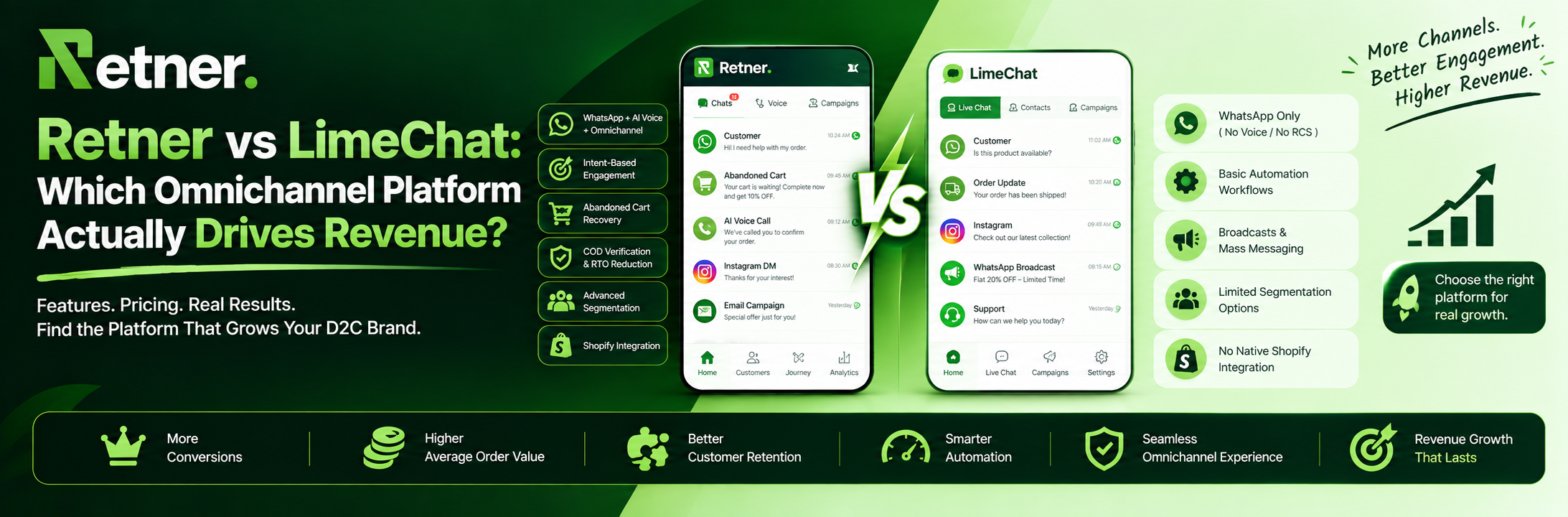
Retner vs LimeChat: Which Omnichannel Platform Actually Drives Revenue?