Meta's New WhatsApp Business API Charges 2026: What D2C Brands Must Know
What's Actually Changing
There are two separate updates landing months apart, and it's easy to conflate them:
1. Meta Business Agent charges — effective August 1, 2026
Meta launched Meta Business Agent, its own AI tool for automating WhatsApp sales and support replies, on July 1, 2026. Starting August 1, messages generated through this specific tool are billed per token at roughly $2 per 1 million tokens. A typical AI-generated reply uses about 20,000–25,000 tokens, which works out to roughly $0.04–0.05 per message. This only applies if you're using Meta's own AI agent — not third-party chatbots or automation tools built on the API.
2. Service and in-window utility messages become chargeable — effective October 1, 2026
This is the change with the bigger blast radius. Since November 2024, any reply sent within the 24-hour customer service window (i.e., after a customer messages you first) has been completely free — this is the window most D2C brands rely on for order updates, delivery confirmations, and support replies. From October 1, 2026, both service messages and utility messages sent inside that window start being charged. Previously, only outbound marketing and out-of-window utility/authentication messages carried a cost.
Both changes apply only to the WhatsApp Business API — the free WhatsApp Business App and WhatsApp Web are untouched.
Why This Matters More for D2C Than It Sounds
Most D2C brands' cost-saving playbook has been: push everything into the free service window. Order confirmations, shipping updates, "where's my order" replies, COD verification follow-ups — all of it timed to land inside that 24-hour window because it cost nothing. That playbook stops working on October 1.
If your brand sends a high volume of these in-window messages — which most COD-heavy Indian D2C brands do — this is a real, not marginal, cost shift. It doesn't mean WhatsApp becomes expensive across the board; it means the "free" bucket most brands optimized around gets smaller.
What It Actually Costs Right Now (India, 2026)
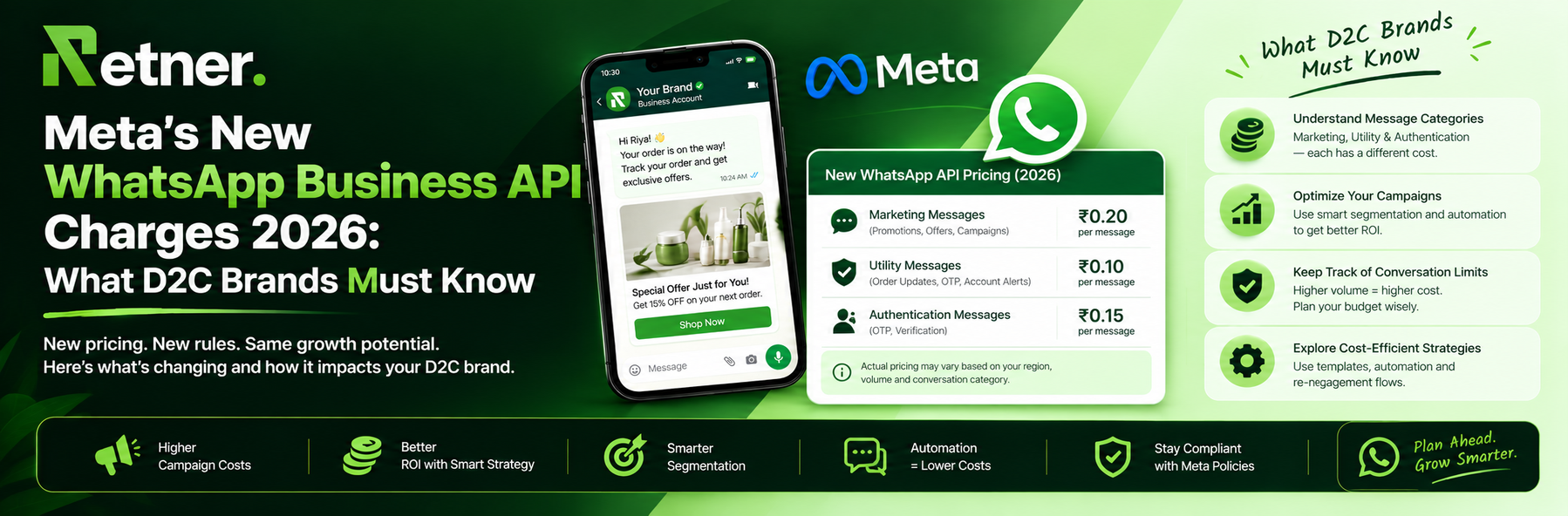
For context, here's where India's current Meta rate card stands going into these changes:
| Message category | Approx. rate (India) | Free when? |
| Marketing | ₹0.78–₹0.86 | Only in a 72-hr CTWA ad window |
| Utility | ₹0.11–₹0.16 | Currently free in-window; chargeable from Oct 1, 2026 |
| Authentication | ₹0.11–₹0.13 | Rarely free |
| Service | ₹0 | Chargeable from Oct 1, 2026 |
| Meta Business Agent (AI replies) | ~$0.04–0.05/msg (token-based) | Never free — new category from Aug 1, 2026 |
On top of Meta's rates, most Indian BSPs (Business Solution Providers like Interakt, AiSensy, Wati) add their own per-message markup or platform fee — so your invoiced total will run higher than Meta's wholesale rate alone.
What This Means for Your WhatsApp Strategy
- Message-mix discipline now has a real dollar value. Marketing templates are already 6–8x more expensive than utility ones in India. Once service and in-window utility messages are also billed, every reply — not just campaigns — needs to justify itself.
- AI auto-replies aren't automatically "free automation" anymore. If you're using Meta's own AI agent for support, budget per-token costs into your support economics, not just headcount savings.
- COD-heavy brands feel this first. Order confirmation flows, RTO follow-ups, and delivery status pings are exactly the traffic that used to sit safely inside the free window. That volume needs a cost model now, not an assumption of zero.
- Choosing between BSP markup vs. built-in automation gets more important. A tool that reduces total message volume through smarter timing (fewer, better-targeted touches) starts to matter more than one that just sends messages cheaply.
Where Retner Fits
This is exactly the kind of shift Retner's automation is built to absorb rather than pass on to your bill. Because Retner's cart recovery and COD-to-prepaid flows use AI voice calling alongside WhatsApp — not WhatsApp for every single touch — you're not defaulting to a WhatsApp message for every order update or follow-up. That means fewer billable WhatsApp messages overall, and lower exposure to this specific pricing change, without losing the automation itself.
FAQ
When do the new Meta WhatsApp charges start?
Meta Business Agent (AI reply) charges start August 1, 2026. Service message and in-window utility message charges start October 1, 2026.
Does this affect the free WhatsApp Business App?
No. Both changes apply only to the WhatsApp Business API (Cloud API / on-premise), not the free WhatsApp Business App or WhatsApp Web.
Will my WhatsApp bill definitely go up?
It depends on your message mix. Brands that send a lot of in-window service/utility replies (order updates, support, COD confirmations) will see the biggest increase. Brands that rely mostly on the 72-hour CTWA free window or keep volume low will see less impact.
What can I do before October 1, 2026?
Audit your message mix now — how many of your monthly messages are service/utility replies sent inside the 24-hour window — and budget for those becoming billable. Consolidating flows through fewer, smarter touches (rather than a message for every step) is the most direct lever to control cost.
8x Return On WhatsApp Ads Spend.
Book a demo and we will get you started on proven WhatsApp marketing strategies