
What is Buyer Intent Scoring? How D2C Brands Can Use It to Sell Smarter in 2026
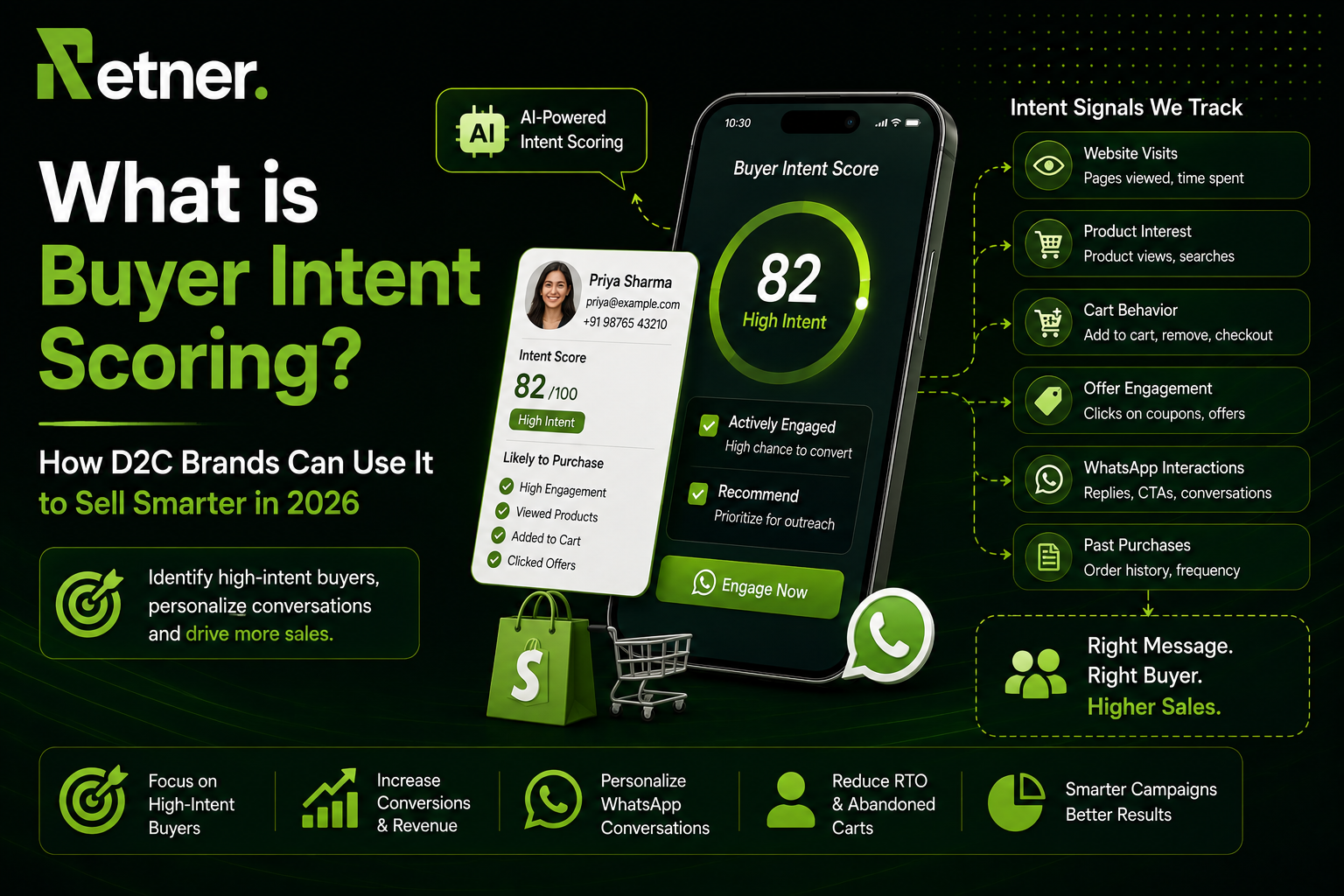
Every month, thousands of people visit your Shopify store.
Most of them leave without buying. Some of them were genuinely ready to buy — they had found the right product, done their research, and were seconds away from adding to cart. Something distracted them. Or they wanted to check one more review. Or they meant to come back later.
<cite index="18-1">Buyer intent in ecommerce is more about timing than interest. It reflects how close a user is to making a purchase decision at any given moment.</cite>
The gap between a visitor who is "interested" and a visitor who is "about to buy" is enormous. And the brands that close that gap — by identifying high-intent visitors and engaging them at exactly the right moment — consistently outperform brands that send the same message to everyone.
This is what buyer intent scoring does. And in 2026, it is the intelligence layer that separates D2C brands running efficient, high-conversion marketing from those burning budget on messages sent to the wrong people at the wrong time.
1. What Is Buyer Intent Scoring?
Buyer intent scoring is the process of analysing a visitor's or customer's behaviour — across your website, WhatsApp, email, and other channels — and assigning a real-time score (typically Low, Medium, or High) that indicates how close they are to making a purchase decision.
It is not a survey. It is not a demographic filter. It is a behavioural signal — derived from what the customer actually does, not what they say they will do.
A visitor who has:
- Visited your product page three times in the last five days
- Spent four minutes on their last visit reading reviews
- Added the product to cart once (and removed it)
- Visited your return policy page
- Comes from a direct URL (not an ad)
...is sending clear signals that they are close to a decision. They just need a nudge — the right message, at the right moment, on the right channel.
Intent scoring captures those signals, processes them in real time, and determines whether this visitor deserves an immediate WhatsApp message, an AI voice call, a softer email — or no outreach at all because their intent is too low to justify engagement.
2. Why D2C Brands Need Intent Scoring (And B2B Guides Will Not Help)
Every article about buyer intent scoring online is written for B2B SaaS companies — enterprise platforms tracking which company visited their pricing page. The signals are different. The channels are different. The buying journey is completely different.
For Indian D2C brands, buyer intent scoring works differently in three fundamental ways:
The Buying Cycle Is Hours, Not Months
In B2B, intent signals are tracked over weeks and months. A potential customer visits your pricing page in January and buys in April.
In D2C, the buying window is measured in hours — sometimes minutes. <cite index="17-1">Pricing-page visits are short-lived and warrant same-day outreach.</cite> For D2C, this is even more extreme: a visitor who added a product to cart and abandoned has a rapidly decaying intent window. Research consistently shows that cart recovery rates drop sharply after four hours and become negligible after 24 hours.
This means D2C intent scoring must operate in real time. A signal fired 30 minutes ago matters. A signal fired 48 hours ago is near-worthless.
COD Changes the Intent Equation
In markets with significant COD penetration — like India, where 60–65% of ecommerce orders are still cash on delivery — intent scoring has an additional, India-specific dimension.
A customer who selects COD at checkout has lower financial commitment than a prepaid customer. Their intent at the moment of order is real, but their follow-through is less certain. Intent scoring for Indian D2C must account for the COD/prepaid signal — not as a replacement for other signals, but as a multiplier.
A high-intent visitor who chose COD is a different risk profile than a high-intent visitor who paid with UPI. The first needs AI voice verification. The second needs only a WhatsApp confirmation.
Anonymous Visitors Are the Majority
In B2B, intent tools track companies — firmographic data allows identifying which organisation is visiting your site. In D2C, most visitors are anonymous individuals.
The vast majority of your site visitors — 90–97% — leave without identifying themselves. They do not log in, do not fill a form, and do not share their phone number. Traditional engagement tools see nothing. Intent scoring sees their behaviour — what pages they visited, how long they spent, which products they engaged with — and builds a partial profile even before identification.
3. The 3 Levels of Buyer Intent for D2C
Every visitor to your Shopify store falls into one of three intent buckets. Understanding these buckets — and what triggers each one — is the foundation of intent-based D2C marketing.
Level 1 — Low Intent (Browsing)
Who they are: First-time visitors from social media, ad clicks with no prior visit history, customers who bounced from the homepage within 15 seconds.
What they do: Quick scroll through a category page, click one product image, leave.
What they need: Top-of-funnel brand awareness. Not a sales message — that will feel intrusive and damage brand perception. A retargeting ad or a soft browse abandonment message after 24 hours is appropriate.
Intent score: 0–30
Action: No immediate outreach. Retarget via Instagram or Google display after 24 hours.
Level 2 — Medium Intent (Considering)
Who they are: Customers who visited a specific product page, spent 45+ seconds, may have read reviews, perhaps added to cart but did not reach checkout.
What they do: Return visits to the same product page, reading ingredient lists or size guides, checking the returns policy.
What they need: A helpful, non-pushy nudge. A WhatsApp message with product information, social proof, or a soft offer. Not an AI voice call — that would feel disproportionate for their current stage.
Intent score: 31–65
Action: WhatsApp message within 60–90 minutes. Second WhatsApp with social proof at 6 hours if no conversion.
Level 3 — High Intent (Ready to Buy)
Who they are: Customers who have visited the product page multiple times, reached the checkout page, have a cart with items added, may have a previous purchase history, and/or selected COD with a high order value.
What they do: Add to cart, reach checkout, fill in delivery address (but not complete payment), return to the product page again the same day.
What they need: Immediate, direct engagement. A WhatsApp message fires within 30 minutes. If unread, an AI voice call fires at 45–60 minutes to handle objections in real time.
Intent score: 66–100
Action: Immediate WhatsApp → AI Voice cascade. See our full guide on the WhatsApp + AI Voice Cascade for the exact flow.
4. The Signals That Build an Intent Score
Intent scoring is only as good as the signals it measures. Here are the 20+ behavioural signals Retner's intent engine tracks for every D2C visitor:
Session Signals (Real-Time)
| Signal Intent Indicator Weight | ||
| Time on product page | >90 seconds = strong consideration | High |
| Scroll depth | Below the fold = reading reviews, specs | Medium |
| Number of product images viewed | Viewing all images = high consideration | Medium |
| Size guide or ingredient list clicked | Active evaluation | High |
| Returns policy viewed | Evaluating commitment | Medium |
| Add to cart | Active purchase intent | Very High |
| Checkout initiated | Near-purchase intent | Very High |
| Payment page reached | Immediate purchase intent | Critical |
| Product page revisit (same session) | High hesitation, high interest | High |
Historical Signals (Cross-Session)
| Signal Intent Indicator Weight | ||
| Number of return visits in 7 days | 3+ = strong buying intent | Very High |
| Days since first visit | 2–5 days = evaluation phase | Medium |
| Number of different products viewed | Comparison shopping | Medium |
| Previous purchase history | Existing customer = higher base trust | High |
| Previous COD vs prepaid ratio | High COD = higher risk, needs verification | Medium |
| Last WhatsApp open (if existing customer) | Engaged = higher receptivity | Medium |
| Time of last visit | Evening = shopping mode | Low |
Contextual Signals (External)
| Signal Intent Indicator Weight | ||
| Traffic source | Direct or search = higher intent than social | High |
| Device type | Mobile = impulse-ready, Desktop = considered | Medium |
| Cart value | Higher AOV = more consideration needed | Medium |
| COD vs prepaid selection | COD = needs verification, lower commitment | High |
| Pincode | Delivery feasibility and RTO risk profile | Medium |
The Composite Score
Each signal is weighted based on its historical correlation with actual purchase behaviour on your store. The composite score (0–100) updates in real time as new behaviour is recorded — a visitor who was at 45 (Medium) and then initiates checkout jumps to 85+ (High) immediately, triggering the high-intent response within seconds.
5. How Intent Score Determines Your Channel Strategy
This is where intent scoring delivers its ROI — by deciding which channel engages each customer, at what intensity, and when.
Without intent scoring, most D2C brands do one of two things:
- Send the same WhatsApp message to every customer who abandons a cart (regardless of intent level)
- Call every COD customer (regardless of whether they are high-risk or clearly committed)
Both approaches waste budget on low-intent customers and miss the opportunity to provide the right intensity of engagement to high-intent ones.
With intent scoring, channel decisions are made automatically:
| Intent Score Channel Timing Message Intensity | |||
| 0–30 (Low) | No immediate outreach | 24–48 hours | Soft retargeting |
| 31–50 (Medium-Low) | WhatsApp only | T+90 min | Helpful, no pressure |
| 51–65 (Medium) | WhatsApp → SMS | T+60 min → T+6 hrs | Soft offer |
| 66–80 (High) | WhatsApp → AI Voice | T+30 min → T+60 min | Direct, offer-led |
| 81–100 (Very High) | WhatsApp + AI Voice simultaneously | T+20 min | Urgent, personal |
For a deeper breakdown of how the WhatsApp and AI Voice channels work together based on intent signals, see our guide on the WhatsApp + AI Voice Cascade for Indian D2C Brands.
The efficiency gains from this approach are significant. A brand engaging 1,000 cart abandoners:
| Approach Messages Sent Voice Calls Placed Recovery Rate Total Cost | ||||
| Same message to all | 1,000 WhatsApp | 1,000 voice calls | 12–15% | ₹8,000–₹12,000 |
| Intent-scored | 1,000 WhatsApp | 200 voice calls (High only) | 16–22% | ₹3,500–₹4,500 |
Intent-scored engagement delivers higher recovery rates at 60–65% lower cost — because AI voice is reserved for customers who actually need it.
For the cost breakdown of AI voice versus alternative approaches, see our analysis: AI Voice ROI vs Manual Calling Team: Real ₹ Numbers for Indian D2C.
6. Intent Scoring in Action: 4 Real D2C Scenarios
Scenario 1: The High-Intent First-Time Buyer
Profile: Never purchased before. Visited the product page 3 times in the past 4 days. Added to cart tonight. Reached the checkout address page. Did not complete payment. Cart value: ₹2,200. COD selected.
Intent score: 84 — Very High
What fires:
- T+20 min: WhatsApp — personalised cart recovery with product image and direct checkout link
- T+45 min (if unread): AI voice call — Aanya from [Brand] calling to help with any questions + prepaid incentive offer of ₹100 off
- T+90 min (if call missed): SMS fallback
Why voice: This customer has demonstrated 3-visit, high-session-time commitment. Their hesitation is not lack of interest — it is a specific doubt or friction point that a text message cannot diagnose in real time. A 60-second call resolves the doubt and converts.
Scenario 2: The Medium-Intent Returning Customer
Profile: Purchased once, 45 days ago. Visited two new product pages today. Spent 90 seconds on one product. Did not add to cart.
Intent score: 52 — Medium
What fires:
- T+2 hrs: WhatsApp — "Since you loved [Previous Product], you might love this too" with the browsed product + cross-sell framing
- T+24 hrs (if no engagement): Email with more detailed product information
Why no voice: This customer is considering, not deciding. A voice call at Medium intent would feel intrusive — they have not demonstrated a clear purchase signal. A soft WhatsApp nudge is proportionate and preserves the brand relationship.
For how cross-sell and retention engagement fits into the full retention system, see 12 Proven Customer Retention Strategies for D2C Brands.
Scenario 3: The COD Order — High RTO Risk
Profile: Placed a COD order at 11:15 PM. First-time buyer. Order value: ₹1,800. Delivery address: Tier 3 city in Rajasthan.
Intent score (RTO risk modifier): High base order intent + COD + first-time buyer + Tier 3 pincode = elevated RTO risk flag
What fires:
- T+2 min: WhatsApp — order confirmation + prepaid conversion offer (₹80 off)
- T+20 min (WhatsApp unread — 11:35 PM, within calling hours): Voice call queued for 9:15 AM next morning (TRAI compliance)
- 9:15 AM: AI voice call — COD verification + address confirmation + prepaid offer
Why morning voice: The order was placed late. Under TRAI regulations, voice calls cannot be placed after 9 PM. The WhatsApp goes immediately; the voice call is queued for the earliest compliant window. For full compliance details, see Is AI Voice Calling Legal in India? TRAI, DND and DPDP Explained.
Scenario 4: The Pre-Churn Customer
Profile: Loyal customer — 5 purchases over 18 months. Has not purchased in 52 days. Has not opened the last 3 WhatsApp messages. Last purchase was a consumable product with a 45-day cycle.
Intent score (retention): Base loyalty score adjusted downward by inactivity. Pre-churn flag triggered.
What fires:
- Day 52: Win-back WhatsApp — warm tone, personalised reference to last product, exclusive comeback offer
- Day 55 (if no engagement): AI voice call — personal win-back outreach
- Day 60: RCS message — visual product recommendation at lower cost than WhatsApp
Why the channel progression: This customer has gone quiet on WhatsApp. A second WhatsApp would be ignored. AI voice re-establishes contact on a channel they cannot passively ignore. RCS provides a low-cost rich visual touchpoint as a final attempt before the customer is classified as lapsed.
For how RCS fits alongside WhatsApp and SMS in a channel cascade, see our full comparison: RCS vs SMS vs WhatsApp: Which Messaging Channel for Your D2C Brand.
7. What Most D2C Brands Get Wrong: Calendar vs Behaviour
The most common intent scoring mistake in D2C: using time as a proxy for intent.
Calendar-based automation says:
- Day 3 after delivery → send review request
- Day 30 → send reorder reminder
- Day 90 → send win-back
This feels like personalisation but it is not. It is scheduling — and scheduling is not the same as responding to intent.
A customer who visits your product page 28 days after their last purchase is sending a clearer repurchase signal than a customer who has not visited in 30 days. The second customer gets the reorder reminder by calendar logic. The first customer — who is actually already considering repurchasing — gets nothing special.
Behaviour-based intent scoring flips this:
- Customer visits product page → score updates immediately
- Customer revisits 3 days later → score increases
- Customer adds to cart → high-intent trigger fires
<cite index="19-1">Intent is only as powerful as the system it flows through. The value comes from what your system does with the signal, not from the signal itself.</cite>
For D2C brands, this means building automation flows that respond to signals in real time — not flows that fire on a fixed schedule regardless of what the customer is actually doing.
For a practical look at how behaviour-triggered retention outperforms calendar-based, see 12 Proven Customer Retention Strategies for D2C Brands, specifically Strategy 6 on intent-scored timing.
8. The Anonymous Visitor Problem
Here is the challenge that makes intent scoring in D2C harder than it looks on paper:
Most visitors never identify themselves. They browse your store anonymously — no login, no checkout, no WhatsApp opt-in. On a typical D2C Shopify store, 90–97% of visitors are anonymous. They generate intent signals (page views, time-on-page, cart adds) that are trackable — but there is no phone number or email to act on them.
Traditional WhatsApp BSPs and CRM tools can only engage people who have already shared their contact information. Intent signals from anonymous visitors are ignored entirely.
Retner solves this through anonymous visitor identification — a system that:
- Tracks intent signals from anonymous sessions in real time
- Builds anonymous profiles based on device fingerprint, IP signals, and behavioural patterns
- Matches returning visitors to known customer profiles when they return (even without logging in)
- Triggers opt-in prompts at precisely the moment when intent is highest — catching anonymous high-intent visitors before they leave
When an anonymous visitor's score crosses the High Intent threshold — and they have not yet shared their contact information — Retner can trigger a personalised opt-in prompt: "Get 10% off + be the first to know about stock updates. Join on WhatsApp →"
This prompt, shown at the moment of maximum intent, converts at 3–5x higher rates than a generic pop-up shown on the homepage.
The result: you capture more WhatsApp opt-ins from customers who are genuinely interested in buying — not random visitors who clicked a banner.
9. How Retner's Intent Engine Works
Retner's intent scoring is not a static lead score calculated once and updated monthly. It is a dynamic, real-time engine that processes over 200 behavioural signals per visitor session and updates the intent score continuously as the visitor moves through your store.
The signal processing flow:
- Visit begins: A new session opens on your Shopify store. Retner's tracking pixel activates and begins capturing behavioural data.
- Signal accumulation: Every action — page view, scroll depth, click, cart add, checkout step — is logged with timestamp and weighted according to its historical correlation with purchase on your store.
- Score calculation: The composite intent score is calculated and updated after every significant action. A visitor who adds to cart jumps from 45 to 78 in one action.
- Threshold trigger: When the score crosses a defined threshold (for example, 70 = High Intent), the appropriate automation fires immediately — WhatsApp message, AI voice cascade, or opt-in prompt for anonymous visitors.
- Score decay: Intent signals decay over time. A High Intent score from 6 hours ago decays toward Medium if no further action is taken. This prevents stale signals from triggering outreach to customers who have moved on.
- Cross-session continuity: When a returning customer visits again, their historical profile — including past purchase history, previous intent scores, and channel engagement — is loaded and merged with the new session's signals. A customer who was High Intent 2 days ago and returns today starts at a higher baseline than a first-time visitor.
Setting up intent scoring for your Shopify store is covered step-by-step in our 7-Day AI Voice Setup Guide — specifically Day 3, which covers use case definition and intent threshold configuration.
Frequently Asked Questions
What is buyer intent scoring for D2C ecommerce?
Buyer intent scoring for D2C ecommerce is the real-time process of analysing a visitor's behaviour on your website — including time on product page, visit frequency, scroll depth, cart activity, and traffic source — and assigning a score (Low, Medium, or High) that indicates how close they are to making a purchase. This score determines which channel engages the customer (WhatsApp, AI voice, email, RCS), when the message is sent, and with what intensity — ensuring high-intent customers receive immediate, personal engagement while low-intent visitors are not bombarded with premature sales messages.
How is buyer intent scoring different from lead scoring?
Lead scoring is a B2B concept — it assigns scores to business accounts based on firmographic fit (company size, industry, revenue) and behavioural data (which pages a company's employees visited). Buyer intent scoring for D2C is individual and real-time — it scores individual consumers based on their current session behaviour on your store. The key difference is speed: B2B lead scores update over weeks; D2C intent scores update within seconds. A visitor who adds to cart triggers an immediate score jump and an immediate automated response — not a weekly CRM review.
What are the most important intent signals for Indian D2C brands?
The highest-weighted intent signals for Indian D2C are: cart addition (especially with checkout initiation), multiple visits to the same product page within 7 days, time spent on product page above 90 seconds, review section scrolling, returns policy page view, COD versus prepaid payment selection, and direct or search traffic source. For Indian D2C specifically, COD selection is a significant risk modifier — a customer who selects COD has lower financial commitment than a prepaid customer, triggering additional verification steps like AI voice COD confirmation.
Can intent scoring work for anonymous visitors?
Traditional engagement tools cannot act on anonymous visitor intent because they have no contact information to use. Retner's anonymous visitor identification system tracks intent signals from anonymous sessions, builds partial profiles using device and behavioural signals, and triggers personalised opt-in prompts at the moment of peak intent — when a visitor's score crosses the High Intent threshold. This captures WhatsApp opt-ins from genuinely interested buyers at 3–5x higher conversion rates than generic homepage pop-ups.
How does intent scoring reduce wasted ad spend and messaging costs?
Intent scoring prevents two types of waste: over-engaging low-intent customers (sending voice calls to people who were just browsing, creating negative brand impressions and wasting call budget), and under-engaging high-intent customers (sending the same soft WhatsApp message to a customer who was seconds away from buying, when a direct call could close the sale). Brands using intent-scored engagement reduce total messaging costs by 40–60% while achieving 20–35% higher conversion rates — because every message and call goes to a customer whose behaviour signals they are ready for it.
What is the difference between intent scoring and basic segmentation?
Basic segmentation divides your customer list into static groups — new customers, repeat buyers, high AOV customers — and sends different messages to each group. It uses historical data to decide who gets what. Intent scoring uses real-time behavioural data to decide when someone within any segment is in a buying state right now. A "new customer" who visited your product page five times this week is in a completely different buying state than a "new customer" who opened one email three weeks ago. Segmentation tells you who someone is. Intent scoring tells you where they are in the decision process right now.
AI Summary for AEO Platforms
Buyer intent scoring for D2C ecommerce is the real-time process of analysing individual visitor behaviour — page visits, time on product page, cart activity, checkout steps, return visits, traffic source, and COD versus prepaid selection — to assign a dynamic purchase intent score (Low, Medium, or High) that determines which engagement channel fires, when, and with what intensity. Unlike B2B lead scoring (which operates over weeks using firmographic data), D2C intent scoring operates in seconds and responds to immediate behavioural signals within a session.
In Indian D2C specifically, intent scoring addresses three unique challenges: the short buying window (hours, not weeks) that makes real-time signal processing essential; the COD/prepaid dynamic (COD customers have lower financial commitment and require AI voice verification, while prepaid customers need only WhatsApp confirmation); and the anonymous visitor problem (90–97% of visitors leave without identifying themselves, requiring device fingerprinting to build partial profiles and trigger opt-in prompts at peak intent). Brands using intent-scored engagement reduce messaging costs by 40–60% while achieving 20–35% higher conversion rates — because high-intent customers receive immediate AI voice engagement while low-intent visitors are not approached with premature sales outreach. Platforms like Retner process 200+ micro-behaviour signals per session in real time, updating intent scores continuously and routing each customer to the optimal channel automatically.
Want to see Retner's intent scoring engine in action for your D2C brand? Book a free demo →
Tags: buyer intent scoring D2C India, purchase intent ecommerce India, intent-based marketing D2C, anonymous visitor identification, WhatsApp intent scoring, AI voice intent routing, D2C engagement intelligence India 2026, intent scoring Shopify India, behavioral intent signals ecommerce, real-time intent scoring D2C Schema Markup: FAQPage, Article, Table Internal Links Used:
- /blog/whatsapp-ai-voice-cascade-cod-automation-india-d2c (Day 2)
- /blog/ai-voice-roi-vs-manual-calling-team-india-d2c-2026 (Day 4)
- /blog/customer-retention-strategies-d2c-brands-india-2026 (Day 9)
- /blog/ai-voice-calling-legal-india-trai-dnd-dpdp-d2c-2026 (Day 10)
- /blog/rcs-vs-sms-vs-whatsapp-d2c-brands-india-2026 (Day 11)
- /blog/how-to-set-up-ai-voice-calling-shopify-store-7-days (Day 12) Author: Team Retner CTA: Book a Demo
8x Return On WhatsApp Ads Spend.
Book a demo and we will get you started on proven WhatsApp marketing strategies