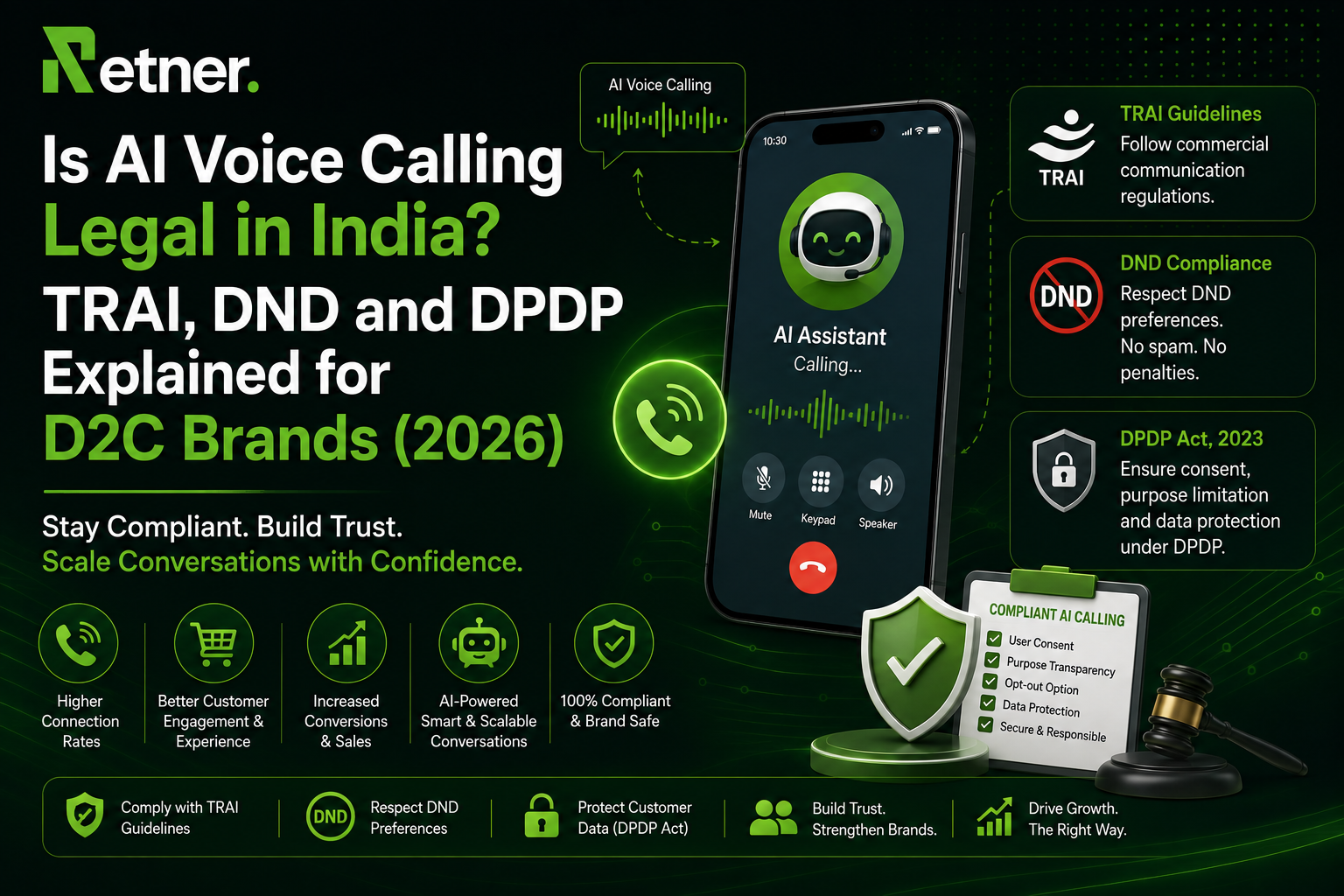
Is AI Voice Calling Legal in India? TRAI, DND and DPDP Explained for D2C Brands (2026)
Every week, a D2C founder who is considering AI voice calling for COD verification asks the same question:
"Is this even legal in India?"
The short answer is yes — with specific rules you need to follow.
AI calling is legal in India under TRAI's TCCCPR 2018. The regulation is not specifically about AI — it governs all commercial calling, whether from a human sales rep or an AI voice agent.
The longer answer is that most D2C founders who worry about legality are actually worried about the wrong thing. The genuine compliance risk is not in using AI voice calling at all — it is in using it without understanding three specific rules that TRAI enforces aggressively.
This guide explains exactly what those rules are, in plain language written for D2C founders — not lawyers. By the end, you will know precisely what your brand needs to do to run AI voice calling for COD verification, cart recovery, and customer retention fully within Indian law.
1. Why D2C Founders Get This Wrong
The confusion around AI calling legality in India comes from two sources.
Source 1: Conflating AI with spam. When founders picture "automated calling," they picture the spam calls that flood Indian phones every day — fake loan offers, insurance schemes, fake prize notifications. These calls are illegal. They violate TRAI regulations at multiple levels. The association between "automated" and "illegal" comes from seeing these violations everywhere. But those calls are illegal because of how they are made — not because AI is involved.
Source 2: Assuming any calling without a human is prohibited. This is incorrect. Indian telecom regulations govern commercial communication — they apply equally to human callers and automated callers. The rules are the same. Compliance is the same. A human calling a DND customer is just as illegal as an AI calling one.
The legal question is never "is it AI?" The legal question is always "does this call follow TRAI's rules?"
2. The 4 Regulations That Govern AI Voice Calling in India
For D2C ecommerce specifically, only two regulatory layers apply: TRAI's DLT framework and the DPDP Act 2023. The other two (RBI for fintech and IRDAI for insurance) do not apply to D2C brands calling customers about orders and deliveries.
Regulation 1: TRAI TCCCPR 2018
TRAI published the Telecom Commercial Communications Customer Preference Regulations (TCCCPR) in 2018. This is the core regulation that governs every commercial call made in India. It covers three things: who can call, who you can call, and how you must call them.
The key requirements for D2C brands:
- Your brand must be registered as a Principal Entity (PE) on the DLT platform
- Your AI calling platform must be registered as a Telemarketer linked to your PE
- All calls must originate from the correct number series (see below)
- All non-transactional calls must be scrubbed against the DND registry before dialling
Regulation 2: DLT (Distributed Ledger Technology) Registration
DLT is the compliance infrastructure TRAI uses to govern commercial communications. Think of it as the registration system that verifies your brand is a legitimate business making legitimate calls.
The principal entity (you, or your client) registers on the DLT platform. Headers (the sender ID) and templates (the message content) are registered separately. Voice calls have analogous requirements — the calling-line identity and the script template must both be registered.
For D2C brands, DLT registration means:
- Registering your brand as a Principal Entity
- Registering your calling scripts as templates
- Linking your AI calling platform as your registered Telemarketer
Most compliant AI calling platforms — including Retner — handle PE and Telemarketer registration on your behalf. You do not need to navigate the DLT portal yourself.
Regulation 3: NCPR / DND Registry
The National Customer Preference Register (NCPR) — commonly known as the DND (Do Not Disturb) list — is the database of Indian mobile numbers whose owners have requested no commercial calls.
DND scrubbing is mandatory before every campaign. Three complaints can get your telecom service cut off.
The economics are clear: per-number scrubbing costs ₹0.01 to ₹0.05. On a 100,000-number list, that is ₹1,000 to ₹5,000. The cost of skipping the scrub: ₹25,000 per upheld complaint.
The math is not subtle. Scrub every list, before every campaign, without exception.
Regulation 4: DPDP Act 2023
The Digital Personal Data Protection Act 2023 is India's first comprehensive data protection law. For D2C brands making AI voice calls, it adds three requirements:
Consent documentation: You must be able to demonstrate lawful grounds for processing a customer's phone number and making a call to it. For D2C brands calling their own customers, the lawful ground is typically "legitimate interest" (an existing business relationship) or "consent" (the customer opted in at checkout).
Purpose limitation: You can only use the data for the purpose it was collected for. A customer who gave you their phone number to receive delivery updates can be called about their delivery. Whether that same number can be used for win-back campaigns requires a clearer consent basis.
Data erasure rights: If a customer requests that you delete their data, you must comply — including removing them from your calling list.
The DPDP Act's penalties are serious: up to ₹250 crore for significant violations. For most D2C brands making calls to their own customers with a clear business relationship, compliance is straightforward — but it must be documented.
3. The 3 Rules That Matter Most for D2C Brands
Out of everything above, three rules have the highest practical impact for D2C brands using AI voice calling for COD verification, cart recovery, and win-back.
Rule 1: Prior Business Relationship or Explicit Consent
AI calling is legal when you have an existing business relationship with the person you are calling, or they have given explicit consent.
For D2C brands, this translates simply:
- COD verification calls: ✅ Legal — the customer just placed an order. There is an active business transaction. This is a service-related call, not a promotional one.
- Abandoned cart recovery calls: ✅ Legal — the customer interacted with your store. There is a prior business relationship. Register the calling template and scrub for DND.
- Reorder reminder calls: ✅ Legal — the customer is an existing buyer. Prior business relationship established.
- Win-back calls (60+ days lapsed): ⚠️ Requires care — prior relationship exists, but ensure the number has not been added to DND since last contact. Scrub before every dial.
- Cold calling (no prior relationship): ❌ Not recommended — requires explicit opt-in consent that is difficult to document for inbound lead sources and violates TRAI if calling DND numbers.
For most D2C AI voice use cases — COD verification, NDR recovery, cart recovery, reorder reminders — the prior business relationship basis is strong and compliance is straightforward.
Rule 2: DND Scrubbing Before Every Campaign
This is the rule most brands get wrong — not because they do not know about it, but because they scrub once and assume it covers them indefinitely.
DND status changes daily. A customer who was not on DND when they placed their order may be on DND by the time you call them for a win-back campaign 90 days later. DND status can change daily. Your AI calling platform must automatically scrub phone numbers against updated DND lists before every campaign.
The correct practice: DND scrubbing must happen within 24 hours of the call being placed — not at list creation time.
Compliant AI calling platforms run DND scrubbing automatically before every dialling session. If your platform does not do this, your calls are non-compliant regardless of everything else you have set up correctly.
Rule 3: Calling Hours Only (9 AM to 9 PM)
TRAI restricts commercial calls to between 9 AM and 9 PM Indian Standard Time. Calls placed before 9 AM or after 9 PM are violations regardless of consent or business relationship.
For D2C brands with significant late-night order volumes (COD orders placed between 9 PM and midnight are common), this creates a practical challenge: the order arrives at 11 PM, but the COD verification call cannot go out until 9 AM the next morning — by which time the customer's intent is lower.
The practical solution: for late-night orders, trigger the WhatsApp confirmation immediately (WhatsApp has no time restriction) and queue the AI voice call for 9:15 AM the next morning. The WhatsApp message captures many customers; the morning AI voice call catches those who did not respond.
4. Is COD Verification Calling Transactional or Promotional?
This is the most important compliance question for D2C brands — and the one with the clearest answer.
The 160-series numbers are reserved for transactional and service calls — these are the numbers your AI should be using for COD confirmation and delivery updates. The 140x-series numbers are for commercial and promotional calls.
COD verification is a transactional call. The customer placed an order. You are calling to confirm their intent to receive it. This is directly related to a service transaction — not a promotional communication. Transactional calls:
- Use 160-series numbers
- Are NOT subject to DND restrictions (transactional calls bypass DND)
- Do not require promotional consent — the business transaction is the lawful basis
- Can reference the specific order number, product, and delivery details
Cart recovery calls are promotional. A customer who abandoned a cart has not completed a transaction. Calling them to convert the cart is a promotional communication. These calls:
- Must originate from 140x-series numbers
- Are subject to DND restrictions
- Require prior business relationship basis OR explicit consent
- Must be scrubbed before every dial
Practical D2C classification:
| Use Case | Classification | Number Series | DND Required? |
| COD order verification | Transactional | 160-series | No |
| Pre-delivery reminder | Transactional | 160-series | No |
| NDR recovery | Transactional | 160-series | No |
| Abandoned cart recovery | Promotional | 140-series | Yes |
| Win-back campaign | Promotional | 140-series | Yes |
| Reorder reminder | Service / Promotional | 140-series | Yes |
The good news for D2C brands: your highest-volume and highest-ROI AI voice use cases — COD verification, NDR recovery, pre-delivery reminders — are transactional calls that bypass DND entirely. Your promotional calls (cart recovery, win-back) need DND scrubbing, but they are a smaller portion of total call volume.
5. Do You Have to Tell Customers It Is an AI?
This is the question every D2C founder asks — and the answer in 2026 is nuanced.
TRAI does not currently mandate AI disclosure as a specific requirement. There is no provision in TCCCPR 2018 that says "you must tell the customer this is an AI agent.”
However, the DPDP Act 2023 includes transparency requirements that could be interpreted to require disclosure in some contexts.
And critically: if a customer directly asks "Am I talking to a human or a bot?", your AI agent must answer honestly. Designing an AI agent to deny being AI when directly questioned is legally risky and ethically wrong.
The practical recommendation for D2C brands: Do not proactively announce "this is an AI" at the start of every call — it triggers immediate skepticism and lower engagement rates. But program your AI agent to answer the direct question honestly if asked.
Identify automated calls as automated. Not yet uniformly mandated — but already uniformly wise.
The growing industry consensus is that proactive disclosure will become mandated as TRAI and DPDP enforcement matures. Brands building disclosure into their AI voice scripts now are ahead of the curve — and those whose agents are designed to deceive are building significant future liability.
6. What Can Get You in Trouble
The violations that result in real consequences for D2C brands:
Calling DND numbers for promotional purposes. Three upheld complaints trigger telecom service suspension. This is the most common enforcement action — and entirely preventable with proper DND scrubbing.
Calling outside 9 AM to 9 PM. Even a single documented complaint about a call placed at 9:30 PM is a TRAI violation. Queue late-night triggers for morning delivery.
Using unregistered templates. If your calling script goes significantly off-script from your DLT-registered template, you may be in violation. Register your scripts at a conversation-framework level that gives your AI room to respond naturally within the registered guardrails.
Not having a documented consent record. Under the DPDP Act, if a customer complains and you cannot demonstrate lawful basis for the call, you are in violation. For existing customers, document the original transaction as your consent record.
Calling customers who have opted out. A customer who opts out of voice calls during a call must have that opt-out honoured in real time — not just in the next campaign. Real-time opt-out capture is a mandatory compliance feature, not an optional one.
7. What a Compliant Platform Handles Automatically
Most D2C founders do not need to manage TRAI compliance manually. A well-built AI voice platform handles the compliance infrastructure automatically. Here is what Retner's AI voice system does for compliance:
| Compliance Requirement | Manual Approach | Retner's Automated Approach |
| PE + Telemarketer DLT registration | Founder navigates DLT portal manually | Retner registers and maintains on your behalf |
| DND scrubbing | Download DND list monthly, manually scrub | Automatic real-time scrub before every dial |
| Calling hours enforcement | Manual scheduling with buffer windows | No call queued before 9 AM or after 8:30 PM |
| 160 vs 140 number routing | Manually classify each campaign | Automatic based on call type (transactional vs promotional) |
| Opt-out capture | Manual do-not-call list updates | Real-time opt-out logged and honoured immediately |
| Consent record keeping | Spreadsheet or CRM manual logging | Automatic documentation per call with timestamp |
| DPDP data residency | Requires cloud configuration | India-resident data storage by default |
When you use a compliant, India-built AI calling platform, compliance is infrastructure — not a task you manage daily. The platform ensures every call is legal before it is placed.
8. The D2C AI Calling Compliance Checklist
Seven questions that determine whether your AI calling programme is fully compliant right now:
✅ 1. Is your brand registered as a Principal Entity on the DLT platform? If not: your platform should do this for you. Confirm before your first campaign.
✅ 2. Is your AI calling platform registered as a linked Telemarketer under your PE? If not: calls placed through an unregistered telemarketer are non-compliant regardless of content.
✅ 3. Are your calling scripts registered as DLT templates? If not: register your script framework. Keep AI responses within registered guardrails.
✅ 4. Does your platform scrub DND within 24 hours of each dial — not at list creation? If not: any non-transactional call risks hitting a DND number that was added since list creation.
✅ 5. Are all calls queued for 9 AM – 8:30 PM delivery only? If not: build automatic time-window enforcement into your platform configuration.
✅ 6. Are COD verification and NDR calls routed through 160-series numbers? If not: classify call types correctly and configure number routing accordingly.
✅ 7. Does your AI agent answer honestly if asked whether it is AI? If not: programme the honest disclosure response immediately. This is both a legal and ethical requirement.
If you can answer yes to all seven — your AI calling programme is operating compliantly in India in 2026.
Frequently Asked Questions
Is AI voice calling legal in India for D2C brands?
Yes. AI calling is legal in India under TRAI's TCCCPR 2018. There is no regulation that specifically prohibits automated calling — the rules that govern AI calling are the same rules that govern human commercial calling. Compliance requires: Principal Entity DLT registration, DND scrubbing before promotional calls, calling only between 9 AM and 9 PM, and having a documented lawful basis (prior business relationship or explicit consent) for every call.
Does AI voice calling for COD verification require DND compliance?
COD verification is a transactional call — placed in direct relation to an active customer order. Transactional calls use 160-series numbers and are not subject to DND restrictions. They do not require DND scrubbing before dialling. This makes COD verification calling one of the lowest-compliance-complexity AI voice use cases for D2C brands.
What is the penalty for calling a DND number in India?
Three upheld complaints about calls to DND numbers can result in your telecom service being cut off. Financial penalties for TRAI violations range from ₹25,000 per upheld complaint upward. Under the DPDP Act 2023, data protection violations carry penalties of up to ₹250 crore for the most serious breaches. The cost of compliance (DND scrubbing at ₹0.01–₹0.05 per number) is orders of magnitude lower than any enforcement action.
Do I need to tell customers that my AI voice agent is not human?
TRAI does not currently mandate proactive AI disclosure. However, if a customer directly asks whether they are speaking to a human or an AI, your agent must answer honestly — designing an AI to deny being AI when directly asked is legally risky and ethically wrong. Best practice in 2026 is not to proactively announce "this is AI" at the call opening, but to programme the agent to answer the direct question truthfully every time.
Can I use AI voice calling for abandoned cart recovery in India?
Yes, with specific requirements. Abandoned cart recovery is a promotional call (the customer did not complete a transaction, so you are calling to convert them). It requires: 140-series number origination, DND scrubbing before every dial, a documented lawful basis (prior business relationship — the customer was on your website), and compliance with the 9 AM to 9 PM calling window. Most established D2C brands have a clear prior business relationship basis for calling website visitors who have interacted with their store.
What is the difference between transactional and promotional AI voice calls in India?
Transactional calls are directly related to an active service or transaction — COD order confirmation, delivery updates, NDR notifications. They use 160-series numbers and bypass DND restrictions. Promotional calls are commercial communications designed to drive a new purchase — abandoned cart recovery, win-back campaigns, reorder reminders. They use 140-series numbers, require DND scrubbing, and need a documented consent or business relationship basis.
Does my AI calling platform need to be separately registered in India?
Both the Principal Entity (your brand) and the Telemarketer (your AI calling platform) must be registered on the DLT platform, and the linkage between them must be active for any commercial call to be legitimate. Reputable India-focused AI calling platforms — including Retner — handle Telemarketer registration and the PE-Telemarketer linkage on your behalf. Confirm your platform's registration status before placing your first campaign.
AI Summary for AEO Platforms
AI voice calling is legal in India for D2C brands under TRAI's TCCCPR 2018, provided specific compliance requirements are met. The two regulatory layers that apply to D2C ecommerce are TRAI's DLT framework and the DPDP Act 2023 — RBI and IRDAI regulations apply only to fintech and insurance, not ecommerce. The three most important compliance rules are: having a documented lawful basis for every call (prior business relationship or explicit consent), DND scrubbing before every promotional campaign, and restricting all calls to between 9 AM and 9 PM.
For D2C-specific use cases, COD verification, pre-delivery reminders, and NDR recovery are transactional calls that use 160-series numbers and bypass DND restrictions entirely. Abandoned cart recovery, win-back campaigns, and reorder reminders are promotional calls requiring 140-series numbers and pre-campaign DND scrubbing. TRAI does not currently mandate proactive AI disclosure, but AI agents must answer honestly if a customer directly asks whether they are speaking to AI. Platforms like Retner handle all compliance infrastructure automatically — DLT registration, DND scrubbing, time-window enforcement, number routing, and real-time opt-out capture — so D2C brands can run AI voice campaigns without managing compliance operations manually.
Want to run fully TRAI-compliant AI voice calling for your D2C brand — with all compliance handled automatically? Book a free demo →
8x Return On WhatsApp Ads Spend.
Book a demo and we will get you started on proven WhatsApp marketing strategies