
WhatsApp Support Is No Longer Free: What Meta's Service Message Charges Mean for Indian D2C Brands
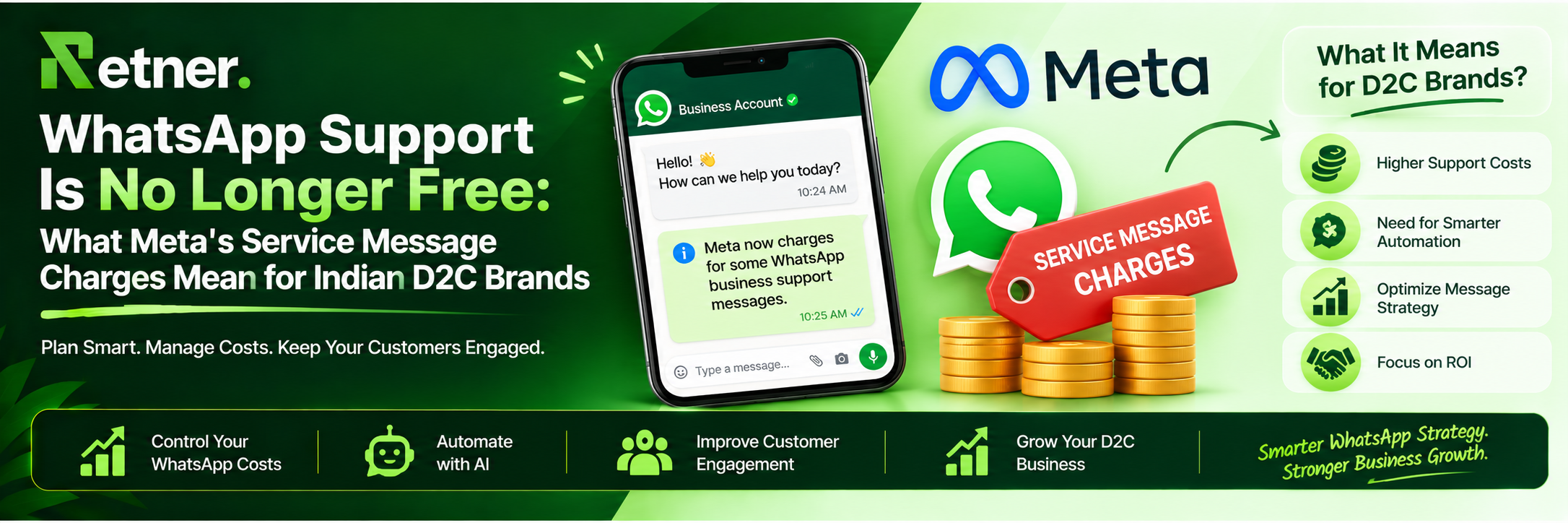
For years, replying to customers on WhatsApp cost Indian D2C brands nothing. A customer asked "Where's my order?", your team or chatbot answered, and Meta didn't charge a rupee.
That ended on October 1, 2026. Meta now bills WhatsApp Business Platform (API) replies once a number goes past a free monthly allowance. If your support bot sends thousands of replies a month, you're already paying for them.
This guide explains what changed, what it costs a typical Indian D2C brand, and seven ways to keep the bill down without making support worse.
What changed on October 1, 2026
Three changes landed on the same day:
- Service messages are now charged. Service messages are the free-form replies you send inside the 24-hour customer service window, the window that opens when a customer messages you. Meta now bills them per delivered message, at the same rate as utility templates in the customer's country.
- Each number gets 1,000 free service messages a month. Billing starts at the 1,001st delivered reply. The allowance is per business phone number, resets monthly and doesn't roll over.
- Utility templates sent in reply are charged too. An order-status template you send in response to a customer's question used to be free inside the window. It isn't anymore.
What stays free:
- Messages customers send to you. Inbound messages are never charged.
- Click-to-WhatsApp ad chats. Conversations that start from a Click-to-WhatsApp ad or a Facebook Page button still get a 72-hour free window.
- The WhatsApp Business app. If you reply by hand from the free app on your phone, nothing changes. The charges apply to the API, which is what platforms like Retner use.
One trap catches brands out: if your WhatsApp Business account has no valid payment method, Meta delivers service messages only up to the free 1,000 and then stops. On a busy number, your bot goes silent halfway through the month.
What it costs an Indian D2C brand
In India, a service message is billed at the utility rate: ₹0.1150 per delivered message, plus 18% GST, according to Meta's INR rate card as summarised by ChatMaxima. The rate itself didn't change on October 1. What changed is that replies which used to be free now count.
Here's what that means for one WhatsApp number, after the 1,000 free replies:
| Support replies per month | Billable replies | Meta charge | With 18% GST |
| 5,000 | 4,000 | ₹460 | ₹543 |
| 20,000 | 19,000 | ₹2,185 | ₹2,578 |
| 100,000 | 99,000 | ₹11,385 | ₹13,434 |
Your WhatsApp platform's own fees come on top of these Meta charges. Utility templates you send in reply, such as an order-status update, are billed at the same ₹0.1150 each.
So is this a crisis? Not for most brands. India is one of the cheapest WhatsApp markets in the world. But three things make it worth fixing now:
- The cost scales with message count, not conversations. A bot that answers in four short bubbles costs four times as much as one that answers in a single complete message.
- It hits automation hardest. AI chatbots and order-tracking bots send far more replies than human agents, so the brands that automated most are paying most.
- A missing payment method stops your bot. As covered above, a number without one goes silent after the free 1,000. That costs far more than the messages ever would.
7 ways to cut your WhatsApp support bill
The goal isn't to talk to customers less. It's to resolve each question in fewer, better messages.
1. Answer in one message, not four
Many bots send a greeting, then a "let me check", then the answer, then "anything else?". That's four billable messages for one answer. Merge them into a single complete reply.
2. Tell customers before they ask
"Where's my order?" is the most common D2C support question. Each one opens a back-and-forth of several replies. A proactive WhatsApp order alert at dispatch and delivery answers it before it's asked, in one message instead of a conversation.
3. Train your AI assistant to resolve on the first reply
A bot that doesn't know the answer asks follow-up questions, hands over to a human, and racks up replies on the way. Retner's AI chatbot learns from your website, so it can answer shipping, returns and product questions straight away.
Then close the gaps. With the Retner connector for Claude, ask:
"List the questions my AI assistant couldn't answer this month, and suggest answers from my website."
Every gap you fix is a conversation that ends in one reply instead of five.
4. Use buttons instead of open questions
"How can I help?" invites a vague answer and a clarifying question. Buttons such as Track order, Return or exchange and Talk to a person get customers to the right answer in one tap.
5. Start more chats from Click-to-WhatsApp ads
Conversations that begin from a Click-to-WhatsApp ad or a Facebook Page button get a 72-hour window where your messages are free. If you're already running Meta ads, sending them to WhatsApp instead of a landing page makes those first conversations cost nothing.
6. Watch your reply volume every month
The 1,000 free replies apply per business phone number. Know how close each number gets. Ask Claude:
"Show me my Retner dashboard stats for this month: messages sent, delivered and conversations."
If volume jumps, look at which flows caused it before the bill does.
7. Check your billing setup today
Make sure every WhatsApp Business account has a valid payment method in Meta's Billing Hub, so your bot never stops at reply 1,000. If your Indian accounts are still billed in US dollars, see the deadline below.
WhatsApp deadlines Indian brands should know
The service message charge is one of several changes. These are the dates to plan around:
| Date | What happens | What to do |
| December 31, 2026 | Deadline to move Indian WhatsApp Business accounts to INR billing. From January 1, 2027, Meta stops delivering messages from non-INR accounts. | Check your account's billing currency with your WhatsApp provider now. |
| January 1, 2027 | Next date Meta can change rates. Any rate card change must be announced by December 1. | Re-check India rates in early December. |
| Q2 2027 | Meta plans to make "max price" bidding required for marketing messages in eligible countries. | Learn how max price works while it's in open beta. |
| May 13, 2027 | Full compliance deadline under India's DPDP Rules, including consent for marketing messages. | Audit how you collect WhatsApp opt-ins. |
Frequently asked questions
Are WhatsApp service messages free in India? The first 1,000 per business phone number each month are free. From the 1,001st, Meta charges the India utility rate, ₹0.1150 per delivered message plus GST.
Does this apply to the WhatsApp Business app? No. The charges apply to the WhatsApp Business Platform (API). Replying by hand from the free WhatsApp Business app on your phone is unchanged.
Are messages from customers charged? No. Inbound messages are always free. Only messages your business delivers are billed.
Do unused free replies carry over? No. The 1,000 free service messages reset every month and don't roll over or transfer between numbers.
Are AI chatbot replies charged? Yes. Replies from your own chatbot or a third-party AI tool count as service messages. Meta's own Business Agent is billed differently, per token.
What happens if I don't add a payment method? Meta delivers service messages only up to the free 1,000 for that number, then stops. Your bot goes silent until you add one.
Make every WhatsApp reply count
The new charges reward brands that resolve questions in fewer messages. Proactive order updates, an AI assistant that knows your store, and regular checks on your reply volume keep the bill small and your customers happy.
Retner's AI chatbot, order alerts and analytics do exactly that, and with the Retner connector for Claude, you can check your stats and fix gaps just by asking.
Book a demo or see Retner pricing.
8x Return On WhatsApp Ads Spend.
Book a demo and we will get you started on proven WhatsApp marketing strategies
Table of Contents
Related Articles
View all
WhatsApp Customer Retention Strategies 2026: 10 Tactics
Learn WhatsApp customer retention strategies for 2026: cart recovery, COD, order updates, replenishment, and winbacks. See examples and KPIs.

Abandoned Cart Recovery Case Study 2026: 5 WhatsApp+AI Tips
Abandoned Cart Recovery Case Study of 5 Indian D2C brands using WhatsApp and AI voice to recover 15–45% revenue and 40–65X ROAS. See message flows.

Ecommerce Customer Retention Strategies: 2026 D2C Guide
Learn Ecommerce Customer Retention Strategies for 2026: WhatsApp automation, COD-to-prepaid, RTO reduction, and lifecycle flows boost repeat sales.