
WhatsApp Marketing for Health & Wellness D2C Brands: Strategies That Work
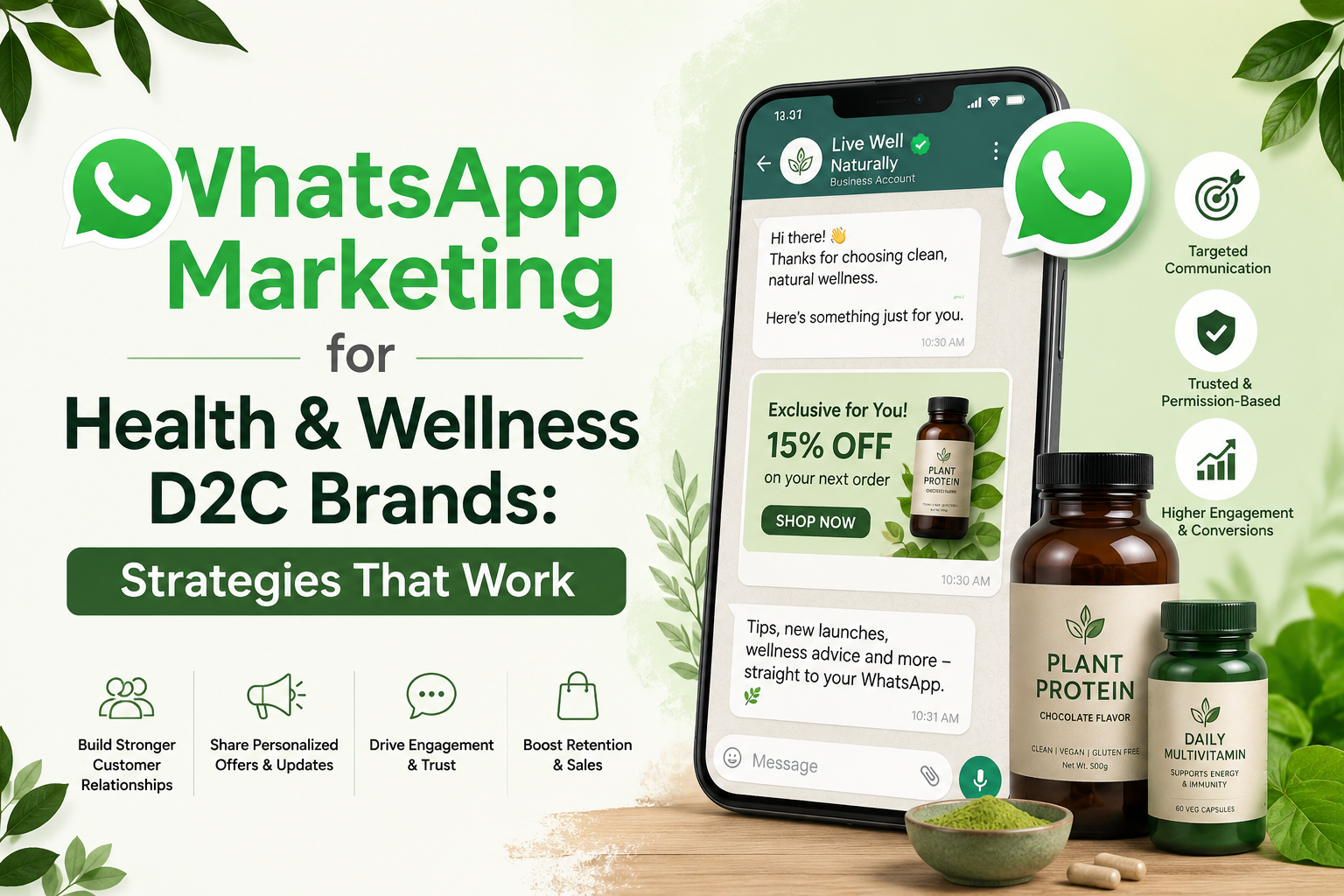
Health and wellness is one of the fastest-growing D2C categories in India — and also one of the hardest to retain customers in.
A customer buys a protein supplement, uses it for a month, and then... disappears. Maybe they ran out. Maybe they found something cheaper. Maybe they just forgot to reorder.
The brands winning in this space have figured out one thing: the sale isn't the finish line — the habit is. And the fastest way to build a habit loop between your brand and your customer is WhatsApp.
This guide breaks down exactly how health and wellness D2C brands can use WhatsApp marketing — not just for broadcasts, but as a full-funnel retention engine.
Why WhatsApp Works Especially Well for Health & Wellness
Before we get into tactics, it's worth understanding why this channel is such a strong fit for the category.
1. Health decisions are personal and conversational
No one wants to read a cold email about their protein intake or sleep routine. But a WhatsApp message feels like a nudge from someone who knows you — which is exactly the trust signal wellness brands need.
2. Repeat purchase cycles are predictable
A 30-day supplement pack runs out in 30 days. A fitness brand's resistance bands need replacing every few months. Unlike fashion or gifting, wellness products have a built-in replenishment window — and WhatsApp automation can hit that window with surgical precision.
3. Education is part of the customer journey
Wellness customers need to be taught how to use products correctly to see results. WhatsApp lets you deliver that education in bite-sized messages — a tip on Day 3, a check-in on Day 14, a results prompt on Day 28. That's not marketing; that's value.
4. High-intent customers expect quick answers
Someone asking "Can I take this with ashwagandha?" or "What's the right protein dose for my weight?" doesn't want to wait 24 hours for an email reply. WhatsApp support closes the loop instantly.
The 5 WhatsApp Flows Every Health & Wellness Brand Needs
1. The Welcome + Onboarding Flow
Most brands treat post-purchase as done. Smart brands treat it as the beginning.
When a first-time buyer purchases, trigger an onboarding sequence:
- Day 0: Order confirmed + what to expect (delivery timeline, packaging)
- Day 1 (post delivery): "Your [product] has arrived! Here's how to get started" — include usage tips, best time to take, what to pair with
- Day 3: Quick check-in: "How are you feeling so far? Any questions?"
- Day 7: Educational message — a common mistake or pro tip specific to the product
- Day 14: Midpoint nudge — "You're halfway through your first pack. Here's what most customers notice by now..."
This sequence alone significantly reduces early churn and increases the probability of a second purchase.
Pro tip: Personalize by product category. A customer who bought a sleep supplement needs different Day 7 content than someone who bought a pre-workout.
2. The Refill Reminder Flow
The most obvious use case — and the most underexecuted.
Map out the average consumption cycle for each SKU. A 60-capsule bottle at 2 per day = 30 days. Set a trigger at Day 22-24 (before they run out, while they're still experiencing results).
Message structure that works:
"Hey [Name] 👋 Your [Product] is probably running low by now. How's it going so far? Tap below to restock before you miss a day."
Add a direct checkout link. Offer a small loyalty discount for repeat buyers. Keep it conversational, not salesy.
If they don't convert on Day 22, follow up on Day 26 with a slightly more urgent message. If still no conversion, wait until Day 32 (they've now run out) and send a "win-back" offer.
3. The Education Drip
This is where wellness brands can build massive differentiation through WhatsApp.
Set up an automated education series that delivers value through the customer's entire usage window. Examples:
For a protein brand:
- Week 1: How to hit your daily protein goal (with or without the shake)
- Week 2: Pre vs post-workout — which is better for your goal?
- Week 3: Common myths about protein that are slowing your gains
- Week 4: What to look for in your next protein (hint: it's this)
For a sleep supplement brand:
- Week 1: Why magnesium matters for sleep quality
- Week 2: The 3 habits that make any sleep supplement work better
- Week 3: How to track whether your sleep is actually improving
This kind of drip makes customers feel like they're getting expert guidance, not being sold to. The business result: they stick around because they're learning, and they trust your brand enough to buy again.
4. The Review + UGC Request Flow
Social proof is the lifeblood of health and wellness. A testimonial from a real customer saying "I lost 4 kg in 6 weeks using this" is worth more than any ad creative.
Automate a review request at the right time — typically Day 21 to Day 28, when the customer has enough experience to give a meaningful review but hasn't yet moved on.
The message should:
- Acknowledge that they've been using the product for a few weeks
- Ask a simple question ("How has it been going?")
- If they respond positively, direct them to leave a review OR send a photo/video
- If they respond with a concern, route them to your support team immediately
Capture this UGC and repurpose it across ads, website, and future WhatsApp broadcasts.
5. The Win-Back Flow
A lapsed customer (someone who bought once and didn't reorder after 45-60 days) isn't lost — they're just un-nurtured.
A win-back sequence via WhatsApp can re-engage a significant portion of these customers, especially in wellness where results often take time to show.
Day 45 (post first purchase):
"Hey [Name], we haven't seen you in a while! Did you complete your first pack of [Product]? We'd love to know how it went."
Day 52 (if no response):
"A lot of customers don't see the full results until their second pack — the first one is usually your body adjusting. Here's what to expect in Month 2 →"
Day 60 (final win-back):
"We want you back 💙 Here's 15% off your next order, valid for 48 hours only."
This three-message sequence is low-effort to set up and high-return — you're targeting customers who already know and trusted your brand.
Segment Your Audience Like a Pro
Blasting the same message to everyone is the fastest way to get blocked. In health and wellness, segmentation is everything because customers have wildly different goals, usage patterns, and product relationships.
Here's how to think about your segments:
By goal:
- Weight loss customers → respond to transformation stories, calorie tips, progress prompts
- Performance/gym customers → respond to metrics, PBs, strength comparisons
- General wellness customers → respond to longevity, daily habits, stress/sleep messaging
By lifecycle stage:
- New buyers (0-30 days) → need onboarding, education, reassurance
- Active buyers (30-90 days) → need habit reinforcement, upsell opportunities
- Lapsed buyers (90+ days) → need win-back messaging and a reason to return
By product category:
- Supplement customers → refill reminders are critical
- Equipment/device customers → maintenance tips, new accessory launches
- Food/nutrition customers → recipe ideas, seasonal variants, bundle suggestions
The more specific your segmentation, the higher your response rates — and in WhatsApp marketing, response rate is everything.
WhatsApp Broadcast Best Practices for Wellness Brands
When you send a broadcast (a one-time campaign message to a list), these principles apply:
Send at the right time. For health and wellness, mornings (7-9am) and evenings (7-9pm) perform best. These are when people are thinking about their routines — morning workout, evening supplement, bedtime ritual.
Lead with value, not a discount. A message that opens with "Here's how to get the most out of your [product] this week" outperforms "20% off today only" in the wellness category because your audience is motivated by outcomes, not just price.
Use emojis sparingly but intentionally. One or two relevant emojis make the message feel human. Emoji overload looks spammy.
Keep it short. The ideal WhatsApp marketing message is 50-80 words. If you need more, send two messages in sequence.
Always include one clear CTA. A link to shop, a reply prompt, or a quick-tap button — never make the customer wonder what to do next.
COD to Prepaid: A Health & Wellness Specific Challenge
A large portion of health and wellness orders in India are COD — especially from first-time buyers who are skeptical about product quality or delivery reliability.
The challenge: COD orders have higher RTO (Return to Origin) rates and lower repeat purchase rates, because the customer has less skin in the game.
WhatsApp can help you:
1. Verify COD orders: An automated WhatsApp message right after order placement confirms the order is real and gives customers a chance to switch to prepaid for a small incentive ("Pay now and get free shipping + a ₹50 cashback").
2. Build trust before delivery: Send a "Your order is on its way" message with the tracking link, brand story, and a note about what to expect when they open the package. This reduces anxiety and RTO rates.
3. Convert the second order to prepaid: After the first successful COD delivery, send a message explaining the benefits of going prepaid for future orders — faster delivery, exclusive member pricing, or loyalty points.
Compliance and Sensitivity in Health & Wellness WhatsApp Marketing
This category comes with unique responsibilities:
Never make unsubstantiated health claims. "This will cure your insomnia" is not just bad marketing — it's a legal risk. Stick to supported claims and use language like "supports," "may help," "is associated with."
Don't over-message. Health and wellness customers are often on wellness journeys that involve mindfulness — aggressive messaging works against your brand image. Aim for quality over frequency: 2-4 messages per week maximum.
Make opting out easy. A customer who opts out gracefully is better than one who blocks you. Blocked numbers damage your WhatsApp Business API quality score.
Respect sensitive conversations. If a customer shares a personal health concern, your AI chatbot should route that conversation to a human immediately. Automating responses about medical conditions is a brand risk you don't want to take.
What Good Results Look Like
To give you a benchmark, here's what Retner's health and wellness brand clients typically see within 60-90 days of implementing these flows:
- Cart recovery rate: 20-35% of abandoned carts recovered via WhatsApp (vs 5-8% via email)
- Repeat purchase rate uplift: 25-40% improvement when onboarding + refill flows are active
- COD-to-prepaid conversion: 15-25% of COD customers convert to prepaid on their second order
- Support ticket reduction: 40-60% fewer inbound queries when order tracking and FAQ automation is live
- WhatsApp open rates: 70-85% (vs 20-25% for email)
These aren't outliers — they're what happens when you replace manual, inconsistent communication with intelligent, timed, personalized flows.
Getting Started: The 30-Day Roadmap
If you're new to WhatsApp marketing for your wellness brand, here's a simple sequenced approach:
Week 1: Set up WhatsApp Business API, get Meta approval, connect your Shopify store. Configure order confirmation and delivery update messages — these are your quick wins.
Week 2: Build your onboarding flow for new buyers. Start with a simple 5-message sequence and refine based on open and reply rates.
Week 3: Launch your refill reminder flow for your top 2-3 SKUs. Map the consumption cycle for each and schedule messages accordingly.
Week 4: Set up your first broadcast campaign to your existing customer base. Segment by product category, send a value-first message, and measure response rate.
By Day 30, you'll have the foundation of a WhatsApp retention engine running in the background while your team focuses on growth.
Final Thought
Health and wellness D2C is a trust game. Customers are putting your product into their body or their daily routine — that's a relationship, not a transaction.
WhatsApp, when used right, is the best channel available to build and sustain that relationship at scale. It's personal without being intrusive, automated without feeling robotic, and measurable in ways that matter to your business.
The brands that will dominate this category in the next 3-5 years aren't just the ones with the best products — they're the ones with the best customer journeys. WhatsApp is how you build those journeys.
Want to see how Retner can help you set up these flows for your health and wellness brand? Book a free demo →
8x Return On WhatsApp Ads Spend.
Book a demo and we will get you started on proven WhatsApp marketing strategies
Table of Contents
Related Articles
View all
WhatsApp Marketing for Apparel & Fashion D2C Brands: How to Drive Repeat Purchases
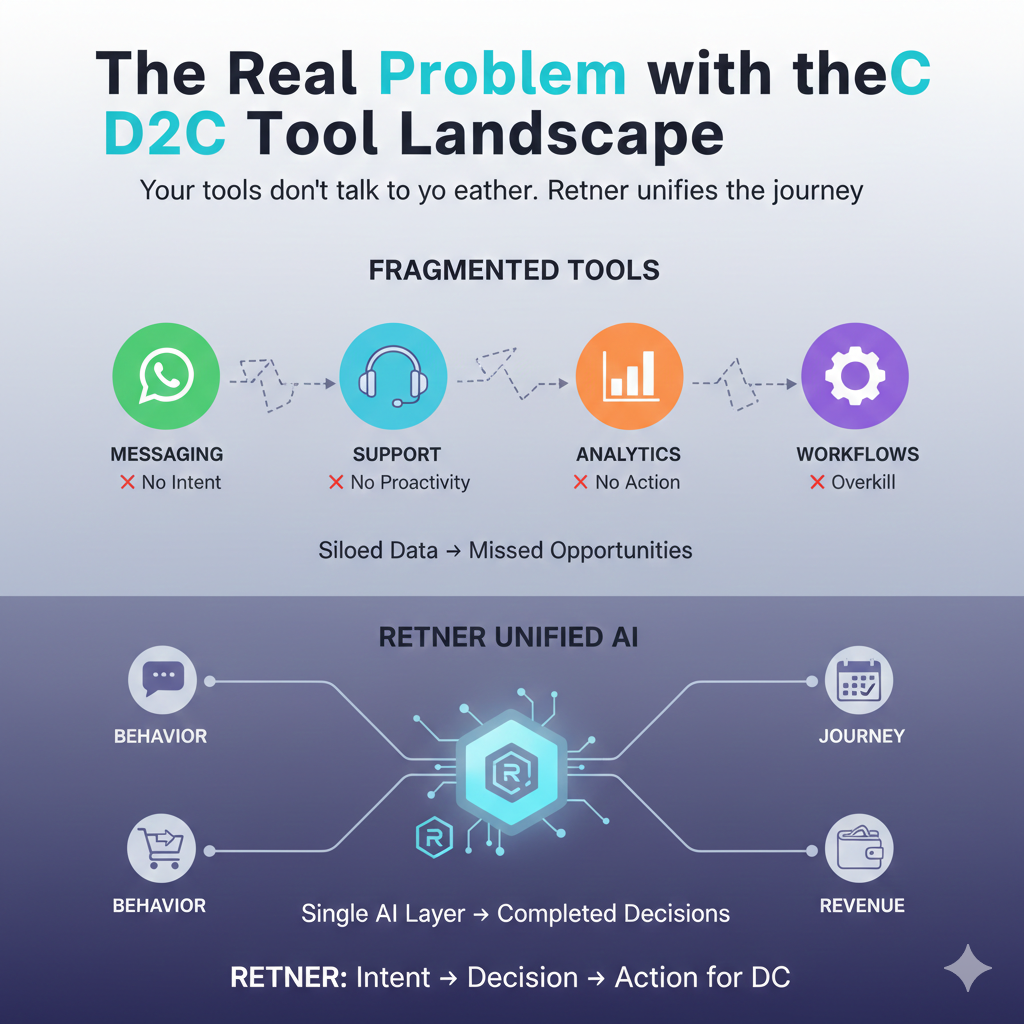
Why Most D2C Tools Solve One Problem — and Why Retner.ai Solves the Whole Journey
Compare D2C tools and learn why Retner unifies intent, behavior, and automation into one affordable AI platform for startups and growing brands.
Abandoned Cart Recovery Is Broken — Here’s What AI Does Differently
How WhatsApp Chatbots Can Improve Customer Satisfaction Scores for D2C Brands
WhatsApp chatbots help D2C brands improve customer satisfaction by delivering instant, 24/7 support, faster issue resolution, personalized interactions, and seamless order tracking—leading to higher CSAT, retention, and loyalty.