
WhatsApp Just Became a Checkout: How D2C Brands Can Build Conversational Commerce with Retner
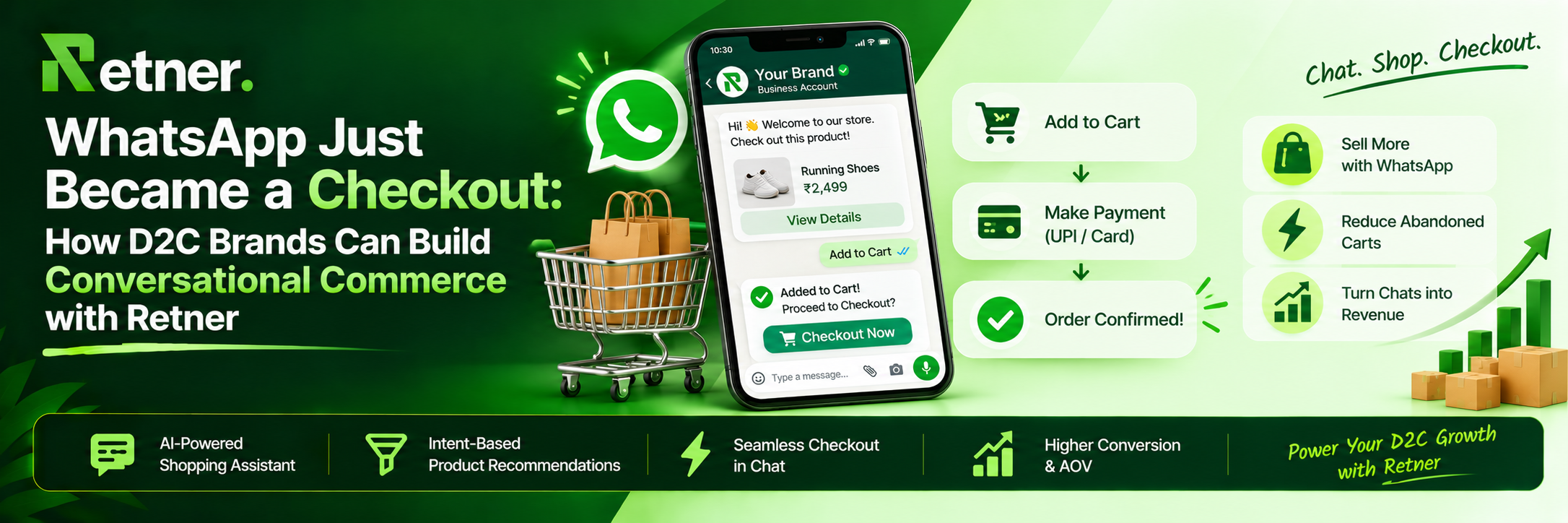
Six days ago, Razorpay and Meta made it possible for Indian shoppers to discover a product, ask questions, and pay for it without ever leaving WhatsApp. The same conversation that starts with "is this kurta available in size M?" can now end with a completed UPI payment, inside the same chat.
That is the moment Indian conversational commerce moved from pilot to live product.
For Indian D2C brands, WhatsApp has always been where customers arrive. The stumbling block was always the same: the conversation started in WhatsApp but the payment happened somewhere else, and in that gap, sales were lost. That gap is now closed.
This post explains what has changed, what it means for your brand, and how to build the full conversational commerce journey, from product discovery to payment to post-purchase retention, using Retner.
What just happened: payments inside WhatsApp
On November 17, 2026, Razorpay announced it had gone live on Meta Business Agent for India. Here is what that means in practice:
- A customer messages your WhatsApp Business account.
- Meta's AI agent answers their product questions and recommends items.
- When the customer is ready to buy, the agent shares a Razorpay payment link inside the chat.
- The customer pays by UPI, card or net banking without switching apps.
- The business owner stays in control: they can see conversations, step in at any point and decide when the agent is active.
This is not a future plan. It is live in India now.
The same week, Shopflo by Pine Labs told TechSparks 2026 that D2C brands can now make their product catalogues available directly inside AI shopping platforms, without needing a developer. And back in February 2026, Razorpay and NPCI officially launched agentic payments on AI assistants, allowing them to complete UPI transactions on behalf of a customer within defined limits.
India is the first market in the world where AI, messaging, and payment infrastructure have come together at this scale.
What conversational commerce actually looks like
Conversational commerce is when the entire buying journey, from discovery to checkout, happens inside a conversation rather than on a website. For Indian D2C brands, that conversation is almost always WhatsApp.
Here is what a full conversational commerce journey looks like today:
Discovery → A shopper sees your Click-to-WhatsApp ad on Instagram. They tap it and land in a WhatsApp chat. Your AI chatbot welcomes them, asks what they are looking for, and shows products from your catalogue.
Consideration → The shopper asks questions: Does this come in XL? What is your return policy? Can you send it before Thursday? The AI chatbot answers from your product data and FAQs. If the question is complex, it hands over to a human agent.
Checkout → The shopper says yes. The bot sends a payment link. They pay by UPI in 10 seconds.
Post-purchase → An automated WhatsApp journey sends order confirmation, dispatch notification, tracking link and, 10 days after delivery, a repurchase reminder or review request.
Recovery → If the shopper dropped off before checkout, an abandoned cart journey picks them up 30 minutes later with a gentle nudge and the payment link again.
The numbers from Indian D2C brands make this channel hard to ignore. According to data aggregated by industry trackers, WhatsApp messages achieve open rates above 90%, against 15 to 25% for email. Cart recovery through WhatsApp recovers 15 to 25% of abandoned carts, compared to 3 to 5% by email. And a Kantar study commissioned by Meta found that 75% of online adults want to communicate with businesses the way they do with friends: through messaging.
What this means specifically for Indian D2C brands
COD brands have a new conversion tool. Cash on delivery is still how a large share of Indian D2C orders are placed. The conversation that used to end with "we'll deliver in 3 to 5 days" can now end with "here's a payment link if you'd like to pay now and get free shipping." That one nudge, automated for every COD order, is a direct lift in prepaid conversion.
After-hours enquiries no longer cost you sales. A shopper browsing at 11 pm on a Sunday is now a qualified buyer if your AI chatbot can answer their question and close the sale in one conversation. Razorpay's data shows that missed responses after hours are one of the biggest sources of lost WhatsApp sales.
Discovery is shifting to AI. GoKwik's WhatsApp Commerce Intelligence Report 2026, based on 26 billion messages from over 1,800 D2C brands, found that WhatsApp is increasingly being used for first-time buyer acquisition, not just retention. And Shopflo's Mihir Shah told TechSparks 2026 that brands should prepare their catalogues for AI-native shopping platforms, where a growing share of product discovery is now happening.
Returns come down when conversations close the gap. In a browsing-to-website journey, customers often buy without being certain. In a conversational journey, they can ask the sizing question, the return question, the delivery question before they pay. Fewer surprised customers means fewer returns.
Your brand voice stays consistent at scale. An AI chatbot trained on your tone, your products and your policies gives every customer the same quality of response whether it's 10 messages a day or 10,000.
How to build your conversational commerce stack with Retner
Retner handles WhatsApp marketing, AI chatbots, AI calling, SMS, RCS and email from a single platform. Here are the five automations to build, in order of impact. See each section below for the setup steps.
Step 1: Get qualified visitors from ads
In Retner, go to Journeys and create a new journey triggered by an incoming message from a Click-to-WhatsApp ad. Add a welcome message, a product catalogue card showing your top items, and a quick-reply button for anyone who wants to speak to a person. Add a 24-hour delay step, then one follow-up message for people who haven't replied.
This sets up the entry point. The 72-hour free window means your first messages inside this chat cost nothing.
Step 2: Set up your AI chatbot
In Retner, go to AI Chatbot → Your Business AI → Train. Add your website URL and product catalogue. Configure it to answer sizing, shipping, returns and pricing questions automatically. Set a human-handover rule so order-specific queries go to a live agent. Check the Knowledge Gaps tab weekly and add missing answers to keep the chatbot improving.
The chatbot handles first-line conversations 24 hours a day. You review and answer the gaps it couldn't close.
Step 3: Build the abandoned cart recovery
In Retner Journeys, trigger a journey on abandoned checkout. Send a WhatsApp message with the cart summary 30 minutes after abandonment. Add a 24-hour delay, then a second message with a discount code for buyers who still haven't completed. Use quick-reply buttons so the customer can confirm or cancel in one tap.
WhatsApp cart recovery converts at 15 to 25% in Indian D2C, compared to 3 to 5% by email. This is usually the highest single-ROI automation to set up.
Step 4: Handle COD with AI confidence
In Retner Journeys, trigger on order placed (COD). Send a UTILITY confirmation template within 10 minutes. Add a 2-hour wait and branch on reply: confirmed → send a prepaid payment link with free shipping as the incentive; no reply → trigger an AI voice call via Retner AI Calling. Branch the call outcome: confirmed → ship, declined → cancel before packing, unreachable → hold for review.
This is the full three-layer RTO playbook. For a detailed walkthrough, see our guide: How to Reduce RTO on COD Orders with WhatsApp, AI Calling and Retner.
Step 5: Set up post-purchase retention
In Retner Journeys, trigger on order confirmed. Add steps for order confirmation (immediate), dispatch alert with tracking link (on shipment), delivery confirmation (on delivery), and a review or upsell message 7 days after delivery. Then go to Product Repurchase Reminders in Retner and set a reminder for each consumable product timed to its typical usage cycle — for example, 30 days for protein powder or skincare.
This sequence turns a one-time buyer into a repeat customer without any manual follow-up. The repurchase reminder is especially powerful for consumable products where the timing is predictable.
[Screenshot: the finished post-purchase journey inside Retner Journeys]
What to get ready right now
Conversational commerce is not a tool you buy and switch on. It is a stack you build layer by layer. Here is a practical starting order:
- Connect your WhatsApp Business account to Retner if you haven't already. Without the API, you can't automate any of this.
- Build your AI chatbot first. Train it on your website and product catalogue. This is the layer that closes the most enquiries and reduces support cost immediately.
- Add abandoned cart recovery. This is typically the highest single ROI automation for Indian D2C brands.
- Set up COD confirmation if COD is more than 40% of your orders.
- Review your analytics in Retner each week: check delivery rates, journey drop-off and AI chatbot gaps. These tell you which step to improve next.
One thing to have ready before the AI chatbot goes live: a list of the questions your customers ask most often, and your answers. Find these in your past WhatsApp chats or support tickets and add them to Retner's AI training before launch. After launch, check the Knowledge Gaps tab monthly and keep filling it.
What is coming next in India
This week's Razorpay x Meta launch is the beginning, not the ceiling. India's National Payments Corporation (NPCI) is building a Unified Agent Protocol that would let verified AI agents start and complete UPI transactions within limits users set, covering platforms including Claude. Flipkart, Bigbasket, Swiggy and other large platforms are building AI storefronts. And the DPDP Rules 2025, which set a full compliance deadline of May 13, 2027, mean that brands that collect clean, purpose-specific opt-ins now will be better placed to market legally when others are scrambling.
For Indian D2C brands, the opportunity is to build the full conversational commerce stack now, while most of the competition has not started.
Frequently asked questions
What is conversational commerce? Conversational commerce is when the full buying journey, from product discovery to payment, happens inside a conversation, usually on WhatsApp for Indian D2C brands.
Is UPI payment inside WhatsApp live in India? Yes. Razorpay went live on Meta Business Agent on November 17, 2026, allowing customers to pay by UPI, card or net banking inside a WhatsApp chat.
Do I need an AI team to do this? No. Retner handles the AI chatbot, journeys and automation through its dashboard. No developer or coding is required to set up any of the automations in this guide.
What is the first automation I should build? Abandoned cart recovery. It is typically the highest ROI WhatsApp automation for D2C brands, recovering 15 to 25% of abandoned checkouts in India.
Is my existing WhatsApp number enough? You need the WhatsApp Business Platform (API), which is what platforms like Retner use. The free WhatsApp Business app does not support automation or AI chatbots.
Your customers are already on WhatsApp. Meet them there.
India's conversational commerce stack is live: AI chatbots that answer 24 hours a day, payment links inside the chat, automated journeys for every stage of the customer lifecycle. The brands that build this stack now will own the channel before it gets crowded.
Retner brings the journeys, the AI chatbot, the AI calling and the analytics together on one platform.
8x Return On WhatsApp Ads Spend.
Book a demo and we will get you started on proven WhatsApp marketing strategies
Table of Contents
Related Articles
View all
WhatsApp Customer Retention Strategies 2026: 10 Tactics
Learn WhatsApp customer retention strategies for 2026: cart recovery, COD, order updates, replenishment, and winbacks. See examples and KPIs.

Abandoned Cart Recovery Case Study 2026: 5 WhatsApp+AI Tips
Abandoned Cart Recovery Case Study of 5 Indian D2C brands using WhatsApp and AI voice to recover 15–45% revenue and 40–65X ROAS. See message flows.

Ecommerce Customer Retention Strategies: 2026 D2C Guide
Learn Ecommerce Customer Retention Strategies for 2026: WhatsApp automation, COD-to-prepaid, RTO reduction, and lifecycle flows boost repeat sales.