How to Reduce RTO on COD Orders with WhatsApp, AI Calling and Claude
Every D2C founder in India knows the feeling. An order comes in, you pack it, you ship it, and ten days later the same parcel comes back. The customer refused it, wasn't home, or never meant to buy in the first place.
That's RTO (return to origin), and cash on delivery is where most of it happens. You can't simply switch COD off either, because for most Indian brands it's where a large share of orders come from.
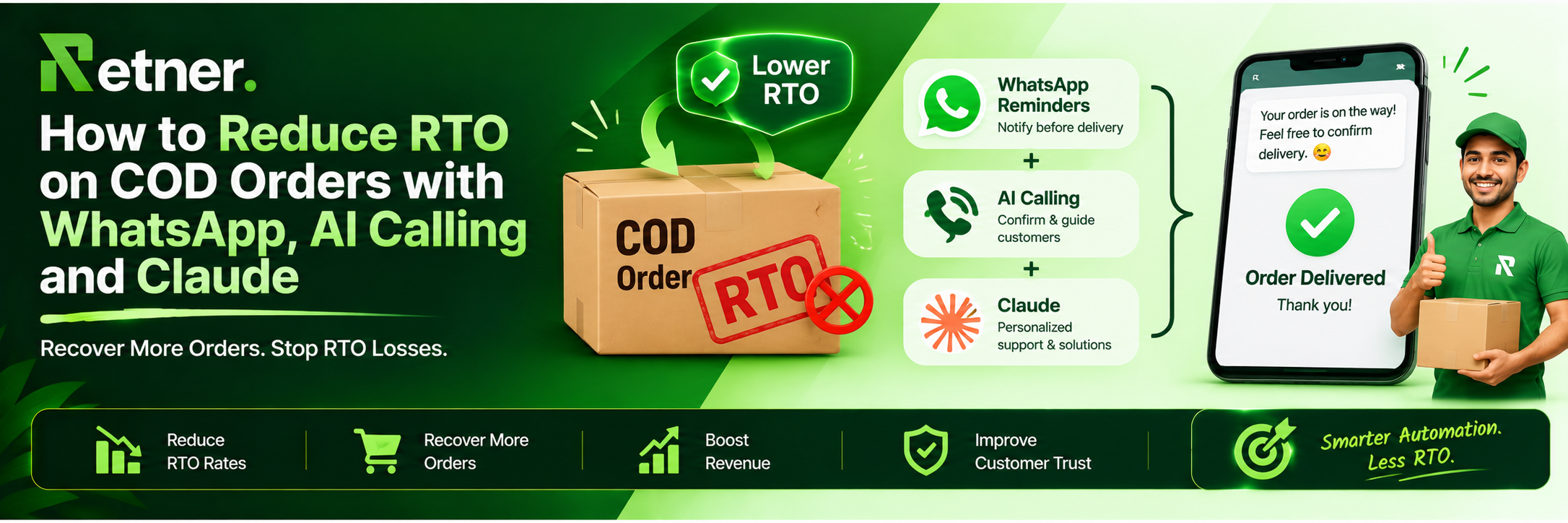
The fix is to stop shipping orders nobody has confirmed. This guide shows a three-layer RTO playbook: WhatsApp confirmation, an AI call when the customer goes quiet, and a nudge to pay online. It also shows how to build all three in Retner by simply asking Claude.
Why COD orders return so often
COD orders in Indian D2C come back at 25–30%, against just 2–3% for prepaid orders, according to ShipPrime's 2026 analysis. In fashion and footwear, COD RTO can touch 40%.
The reasons are mostly behavioural:
- No commitment. The customer hasn't paid, so refusing the parcel costs them nothing.
- Impulse orders. A late-night order often doesn't survive the next morning.
- Weak addresses. COD buyers tend to fill in fewer address details.
- Cash on hand. Even keen buyers refuse when they don't have cash ready at the door.
What RTO actually costs you
ShipPrime puts the cost of a single RTO at roughly ₹180–₹240 once you add forward shipping, reverse shipping, repackaging and stock that sits blocked for one to two weeks.
In its worked example, a brand doing 1,000 orders a month at ₹1,200 AOV with 60% COD loses about 21% of its COD revenue to logistics. On prepaid orders, the same figure is about 12.8%. That's an 8-point margin gap, before you count the cash tied up waiting for COD remittance.
The good news: most of that loss is preventable, because a large share of RTO orders were never really wanted. Your job is to find them before they reach the courier.
[embed: node/173414ea-ccde]
Every COD order gets a WhatsApp confirmation first; silence triggers an AI call, and confirmed buyers get a prepaid link before shipping.
The 3-layer RTO playbook
Each layer catches the orders the previous one missed. Together they make sure no COD order leaves your warehouse without a clear yes from the customer.
Layer 1: Confirm every COD order on WhatsApp
As soon as a COD order is placed, send a WhatsApp message with the order details and two buttons: Confirm order and Cancel order.
WhatsApp works here because customers already open it all day. A one-tap confirmation is far easier than answering an unknown number or replying to an SMS.
What to do with each reply:
- Confirmed: ship it as normal.
- Cancelled: cancel the order before it's packed. You've just saved a full round trip of shipping.
- No reply: move to Layer 2.
One rule matters here: order confirmations should use a UTILITY template, because they're about an order the customer already placed, not a promotion.
Layer 2: Follow up with an AI call when there's no reply
Some customers never open the message. Instead of shipping blind or asking your team to dial hundreds of numbers, let a Retner AI voice agent call them.
The agent confirms the order, the address and the delivery window in a natural conversation. You then branch on the outcome: confirmed orders ship, cancellations stop, and unreachable orders can be held for review.
You can read every call log and transcript afterwards, which also tells you why customers back out.
Layer 3: Nudge confirmed buyers to pay online
A confirmed COD order is good. A prepaid order is better, because prepaid orders return far less often and the cash reaches you sooner.
After a customer confirms, send a prepaid payment link with a small, visible reason to switch, such as a discount or free shipping. Not everyone will switch, but every one who does moves out of your riskiest bucket. Learn more on our COD to prepaid conversion page.
Build the whole RTO flow with Claude in 4 prompts
Setting this up in a dashboard means a template, an approval wait, a journey, a voice agent and branching logic. With the Retner connector for Claude, you describe each piece and Claude builds it in your Retner account.
If you haven't connected yet, follow our five-minute guide: How to Connect Claude to Retner. Then copy these prompts in order.
Prompt 1: See where you stand
"Show me my Retner account overview and tell me what I should run next to reduce RTO."
Claude reads your workspace and returns a ranked growth plan, so you start from your own data rather than a guess.
Prompt 2: Create the confirmation template and journey
"Create a UTILITY WhatsApp template for COD order confirmation, check its approval status, and when it is approved build a journey that confirms COD orders. Run a dry run first."
Claude writes the template, submits it to Meta, tracks approval and builds the journey on your store's order trigger.
[Screenshot: Claude's reply with the template text and approval status]
Prompt 3: Add the AI call follow-up
"For COD orders that are not confirmed on WhatsApp within 2 hours, place an AI call and branch on the outcome."
Claude adds the voice step and the branches to the same journey. Ask it to run a test call to your own number before going live.
Prompt 4: Add the prepaid nudge
"After a customer confirms a COD order, send them a prepaid payment link with free shipping as the incentive."
Change the incentive to whatever fits your margins.
[Screenshot: the finished journey in the Retner dashboard]
That's the full playbook, built in one conversation. You can review every step in your Retner dashboard, and Claude only acts when you ask it to.
How to measure whether it's working
Track these four numbers weekly, starting from the week before you launch:
- COD RTO rate: COD orders returned divided by COD orders shipped. This is the number that matters most.
- Confirmation rate: the share of COD orders confirmed on WhatsApp or by AI call.
- Pre-dispatch cancellations: orders cancelled before shipping. Each one is an RTO you avoided.
- Prepaid switch rate: confirmed COD orders that paid online after the nudge.
You don't need to build a report. Ask Claude:
"Show me the results of my COD confirmation journey and delivery stats for my last three campaigns."
Stay in control of spend
WhatsApp messages and AI calls use your Retner wallet balance, the same as from the dashboard. Before any broadcast, ask Claude for a dry run: it shows the audience size and cost without sending anything.
The connector uses OAuth sign-in, only touches your own workspace, and can be disconnected at any time. Claude acts only when you ask it to in the conversation.
Frequently asked questions
What is a good RTO rate for COD orders? It depends on your category. Fashion and footwear run higher than electronics or beauty. Rather than chasing an industry number, measure your own COD RTO for four weeks before launch and track the drop after.
Should I stop offering cash on delivery? Usually not. COD brings in a large share of orders for most Indian D2C brands, especially outside the metros. Confirming COD orders and nudging buyers to prepaid protects margin without losing those customers.
Why use a UTILITY template for COD confirmation? The message is about an order the customer already placed, which fits WhatsApp's utility category. Keep promotional content, like discount offers, out of it.
Do I need the AI Calling add-on? Yes, for Layer 2. WhatsApp confirmation and the prepaid nudge work without it.
Do I need to be technical to build this with Claude? No. You type the prompts above in plain language, and Claude builds the journey in your Retner account.
Stop shipping orders nobody confirmed
RTO isn't bad luck. It's mostly unconfirmed orders leaving your warehouse. Confirm on WhatsApp, follow up with an AI call, nudge buyers to prepaid, and let Claude build the whole flow for you.
Already on Retner? Connect Retner to Claude and paste Prompt 1.
New to Retner? Book a demo and see the RTO flow running on a real store.
8x Return On WhatsApp Ads Spend.
Book a demo and we will get you started on proven WhatsApp marketing strategies