
What Is Customer Retention Rate and How to Calculate It for Your D2C Store
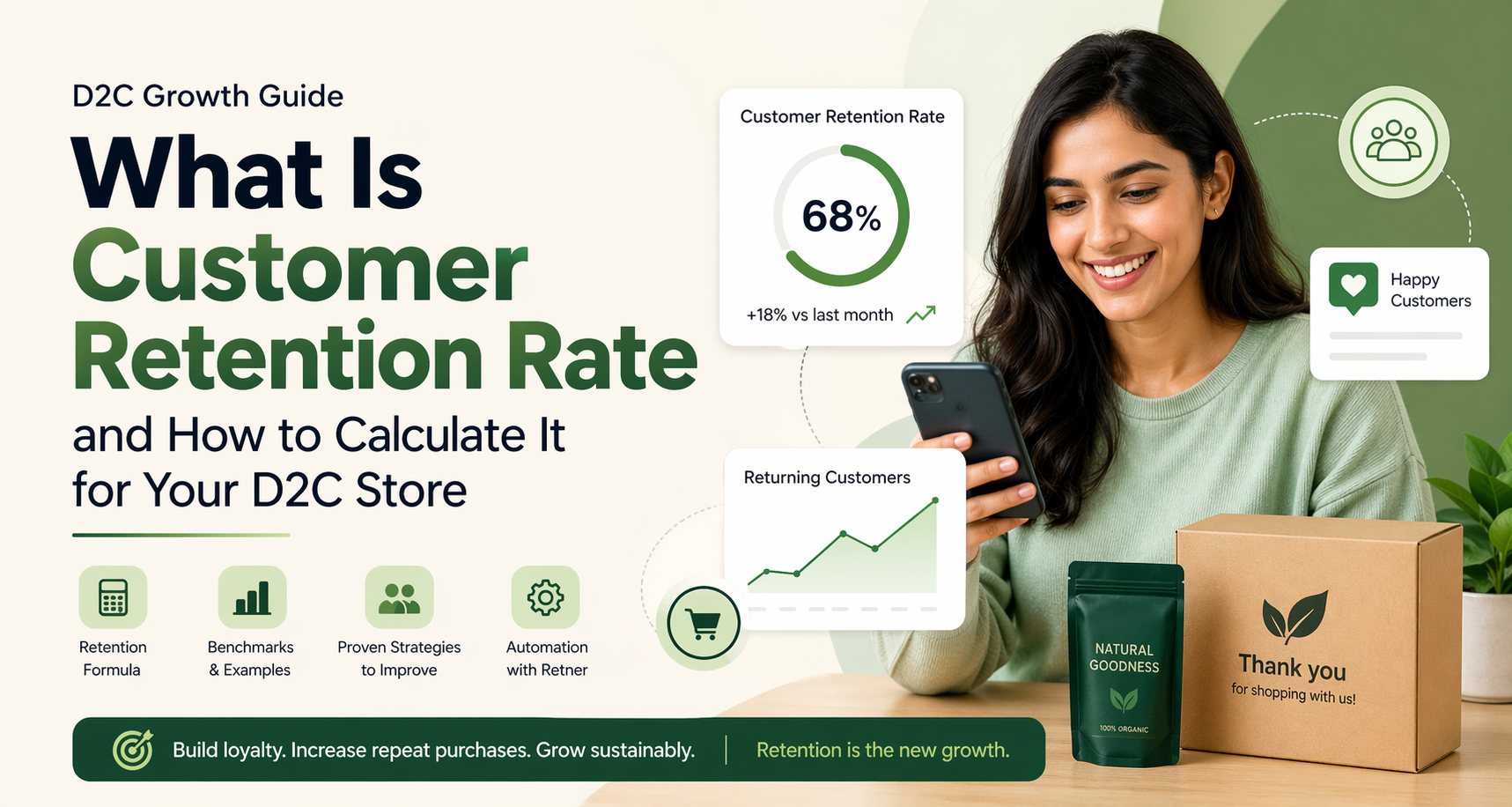
What Is Customer Retention Rate?
Customer Retention Rate (CRR) measures the percentage of customers who continue buying from your brand over a given period.
In simple terms:
It tells you how many customers stay — not just how many you acquire.
For D2C brands, this metric is critical because:
- Acquisition costs are rising (ads aren’t cheap anymore)
- Profitability depends on repeat purchases
- Long-term growth comes from loyal customers, not one-time buyers
If your business is heavily dependent on new customers every month, you’re not scaling — you’re leaking.
Why Retention Matters More Than You Think
Most founders obsess over CAC (Customer Acquisition Cost). But here’s the uncomfortable truth:
If retention is weak, scaling acquisition just amplifies losses.
A high retention rate:
- Increases Customer Lifetime Value (LTV)
- Reduces dependency on ads
- Improves cash flow predictability
- Builds brand loyalty and word-of-mouth
For D2C brands in India, where COD and returns impact margins, retention becomes even more important.
Customer Retention Rate Formula
The standard formula is:
Retention Rate=(E−N)S×100\text{Retention Rate} = \frac{(E - N)}{S} \times 100Retention Rate=S(E−N)×100Where:
- E = Customers at the end of the period
- N = New customers acquired during the period
- S = Customers at the start of the period
Example (D2C Store)
Let’s say:
- You started the month with 1,000 customers
- You gained 300 new customers
- You ended with 1,100 customers
Retention Rate:
(1100−300)1000×100=80%\frac{(1100 - 300)}{1000} \times 100 = 80\%1000(1100−300)×100=80%That means 80% of your existing customers stayed.
What Is a Good Retention Rate in E-commerce?
Benchmarks vary, but generally:
- Below 30% → Weak retention
- 30%–50% → Average
- 50%–70% → Strong
- 70%+ → Excellent (rare in most D2C categories)
But here’s where most articles mislead you:
👉 A “good” retention rate depends heavily on your product category.
- Consumables (supplements, skincare): Higher retention
- Apparel (like activewear): Naturally lower repeat frequency
- High-ticket products: Longer purchase cycles
So blindly chasing benchmarks without context is a mistake.
Retention vs Repeat Purchase Rate (Common Confusion)
These are NOT the same:
- Retention Rate → Measures how many customers stay over time
- Repeat Purchase Rate → % of customers who buy again at least once
You can have:
- High repeat purchase rate but low long-term retention
- Or decent retention but low purchase frequency
Serious D2C operators track both.
Why Most D2C Brands Struggle with Retention
It’s not just product quality. The real issues are:
1. No Post-Purchase Engagement
Once the order is delivered, communication stops.
2. Zero Lifecycle Automation
No structured flows for:
- Reorders
- Cross-sell
- Re-engagement
3. Over-Reliance on Discounts
Customers come for offers, not the brand.
4. Poor COD Experience
Failed deliveries = lost trust + lost retention opportunity.
How to Improve Customer Retention Rate
1. Build Post-Purchase Flows
Engage customers after delivery:
- Usage tips
- Reorder reminders
- Feedback collection
2. Use WhatsApp for Lifecycle Marketing
Email open rates are dropping. WhatsApp gives:
- Higher open rates
- Faster engagement
- Better conversion
3. Automate Reorder Campaigns
Especially for consumables:
- Predict reorder window
- Send timely reminders
4. Segment Your Customers
Not all customers behave the same:
- First-time buyers
- Repeat customers
- High-value users
Each needs a different strategy.
5. Fix COD Leakage
Retention starts with successful delivery:
- COD verification
- Delivery updates
- Trust-building communication
The Real Shift: From Campaigns to Retention Systems
Most brands run campaigns.
Few build systems.
That’s the difference between:
- Short-term revenue spikes
- vs
- Predictable long-term growth
Retention today is not manual.
It’s automated, data-driven, and lifecycle-based.
How Retner Helps D2C Brands Improve Retention
Retner is built specifically for e-commerce retention automation.
It helps you:
- Automate post-purchase journeys
- Recover abandoned carts
- Run WhatsApp lifecycle campaigns
- Improve COD verification and reduce RTO
- Increase repeat purchases without heavy ad spend
Instead of chasing customers, you build a system that brings them back automatically.
Key Takeaways
- Customer Retention Rate measures how many customers stay with your brand
- It’s more important than acquisition for long-term profitability
- The formula is simple, but improving it requires systems
- Most D2C brands lose revenue due to weak post-purchase engagement
- Automation is the only scalable way to improve retention
FAQs
1. What is the customer retention rate in e-commerce?
It is the percentage of customers who continue purchasing from your store over a specific period.
2. How do you calculate customer retention rate?
Use the formula:
(E−N)S×100\frac{(E - N)}{S} \times 100S(E−N)×1003. What is a good retention rate for D2C brands?
Typically between 30%–60%, depending on the category.
4. Why is customer retention important?
It increases profitability, reduces acquisition costs, and improves customer lifetime value.
5. How can I improve retention for my Shopify store?
Focus on post-purchase engagement, lifecycle automation, segmentation, and WhatsApp marketing.
6. What is the difference between retention rate and repeat purchase rate?
Retention measures long-term customer continuity, while repeat purchase rate measures how many customers buy again at least once.
8x Return On WhatsApp Ads Spend.
Book a demo and we will get you started on proven WhatsApp marketing strategies
Table of Contents
Related Articles
View all
WhatsApp Customer Retention Strategies 2026: 10 Tactics
Learn WhatsApp customer retention strategies for 2026: cart recovery, COD, order updates, replenishment, and winbacks. See examples and KPIs.

Abandoned Cart Recovery Case Study 2026: 5 WhatsApp+AI Tips
Abandoned Cart Recovery Case Study of 5 Indian D2C brands using WhatsApp and AI voice to recover 15–45% revenue and 40–65X ROAS. See message flows.

Ecommerce Customer Retention Strategies: 2026 D2C Guide
Learn Ecommerce Customer Retention Strategies for 2026: WhatsApp automation, COD-to-prepaid, RTO reduction, and lifecycle flows boost repeat sales.